
Mobile Top Up Casino UK: Complete Guide to Pay by Phone Deposits 2026
 Available in GB

You want to deposit at a UK casino without handing over card details. Fair enough. Mobile top-up lets you charge the casino directly to your phone bill — enter a number, confirm via SMS, done. Instant. No bank login, no stored credentials — the charge simply appears on your monthly statement or comes off your prepay balance.
The catch? Not every UKGC-licensed casino accepts it. The ones that do often bury a £2.50 fee on top of your deposit — £10 becomes £12.50 at checkout. A handful charge nothing. Each deposit is capped at £30, with a typical monthly ceiling of around £240, enforced by your network and payment processor, not the casino. Withdrawals never come back to your phone. You will need a second method for cashout.
This guide maps which UK operators accept mobile billing in 2026, what it costs at each one, how the mechanics work across EE, O2, Vodafone and Three, and where the friction points sit. Fonix replaced Boku as the dominant processor during late 2024 and early 2025, but many casino cashiers still use “Boku” branding. Payforit was decommissioned in 2023. Zimpler, often mentioned alongside these names, is not available at UK casinos. Virgin Mobile and Sky Mobile block gambling transactions outright.
The zero-fee operators — IvyCasino, Oreels, Bet442, Rose Casino — all run under Betable Limited, which is licensed by the UK Gambling Commission (check the number on the public register). Most of the rest of the market adds £2.50 per deposit. Jumpman Gaming operates 50+ brands on the same fee structure. If you deposit twice a week, that £2.50 compounds to £260 a year in friction. Worth knowing where the exceptions sit.
What Is Mobile Top-Up Casino Payment in the UK?
Mobile top-up casino payment charges your deposit directly to your phone account. You select the option at the casino cashier, enter your mobile number, receive an SMS with a confirmation PIN, approve it, and the funds appear in your casino balance within seconds. The charge lands on your next monthly bill if you are on contract, or deducts from your available credit if you are on pay-as-you-go.
The payment never touches your bank. The casino never sees card details. Fonix, or a smaller aggregator such as PayviaPhone at a few operators, handles the transaction through your mobile network. The network bills you. The casino receives cleared funds instantly. From the player’s perspective, it is the fastest deposit method available in the UK market — approval to balance in under 30 seconds on a working flow.
Three entities sit in the chain: the casino (licensed by UKGC), the payment processor (Fonix dominates as of 2026), and your mobile network (EE, O2, Vodafone, Three). Each has a role. The casino initiates the charge request. The processor routes it through the network’s carrier-billing system under phone-paid services regulation, overseen by Ofcom since the Phone-paid Services Authority’s functions moved there in February 2025. Caps apply throughout — £30 per transaction is standard, with a typical monthly ceiling of around £240, though some networks set lower limits.
Boku used to dominate this market, and many casino pages still talk about “Boku casinos.” During late 2024 and early 2025, Fonix took over most UK casino carrier billing, and casinos migrated their back-end integrations without changing the player-facing flow. The brand recognition simply lags the market reality.
Withdrawals cannot return to your phone bill, so you will need PayPal, a debit card, Skrill or bank transfer for cashout. The section on withdrawals below explains why.
How long does a mobile deposit take to appear in my casino account?
Instant. SMS confirmation to balance update runs under 30 seconds on a clean transaction. If the payment processor times out or your network rejects the charge, you see an error before any money is taken, and failed transactions do not appear on your bill. Persistent failures usually mean a cap or a premium-billing block.
Top UK Casinos Accepting Mobile Top-Up Deposits (2026)
Eleven UKGC-licensed operators with substantive mobile-billing infrastructure made the shortlist. Four charge zero fees. Seven add £2.50 per deposit. Rankings weight fee transparency, withdrawal speed, game variety, and verifiable licensing. Jumpman Gaming operates 50+ brands on identical infrastructure — three representatives appear here to show the pattern without redundant listings.
| Casino | UKGC Licence | Min Deposit | Deposit Fee | Key Feature |
|---|---|---|---|---|
| IvyCasino | Betable (check register) | £10 | £0 | Zero fees, Grace Media games |
| Oreels | Betable (check register) | £10 | £0 | Est. 2017, 1,000+ slots |
| Bet442 | Betable (check register) | £10 | £0 | Sports-first, Bet Builder, live streaming |
| Rose Casino | Betable (check register) | £10 | £0 | Mobile-first UX, fast payouts |
| Funky Jackpot | Check register | £10 | £2.50 | 2,800+ games (largest library) |
| Crystal Slots | Check register | £10 | £2.50 | NetEnt, Playson, Pragmatic Play |
| Mogobet | Check register | £10 | £2.50 | Fast withdrawals |
| Great Britain Casino | Check register | £10 | £2.50 | Bonus value |
| Thor Slots | 39175 (Jumpman) | £10 | £2.50 | Norse theme, Mega Reel, 1,100+ games |
| Amazon Slots | 39175 (Jumpman) | £10 | £2.50 | Bingo adjacency, Mega Reel |
| Wizard Slots | 39175 (Jumpman) | £10 | £2.50 | Est. 2017, 1,500+ games, wizard theme |
IvyCasino
IvyCasino runs on Betable Limited’s Manchester-based operation, licensed by the UK Gambling Commission (check the number on the public register). We found no fines or enforcement actions against it on the register. Grace Media provides the game catalogue. The welcome package offers 100% match up to £50 on first deposit. Minimum deposit £10, processed as exactly £10 — zero deposit fee.
That last point bears repeating. Betable Limited is one of the very few licensees in the UK mobile-billing market that charges nothing to deposit by phone. IvyCasino, Oreels, Bet442, and Rose Casino all operate under this umbrella. Most other operators add £2.50 on top. Deposit £10 at a Jumpman Gaming site and £12.50 leaves your phone bill. Deposit £10 at IvyCasino and £10 leaves your bill. Twice a week across a year, the difference is £260.
IvyCasino skews slots-heavy. Live casino exists but the depth sits in the reels catalogue. PayPal, Skrill, and debit cards handle withdrawals — processing times sit at 24 to 48 hours. Your age and identity are checked before you can deposit, as UKGC rules require, so the first cashout usually only needs your withdrawal method confirmed. Mobile-billing players appreciate the fee structure; slots players appreciate the provider mix. If your priorities align, this is the baseline zero-fee option.
Oreels
Oreels launched in 2017 under the same Betable technology stack that powers IvyCasino. Check the UKGC licence details in the footer against the public register before you deposit. The platform targets slots enthusiasts — 1,000+ titles, fast payouts, mobile-optimised interface.
Zero deposit fees apply here too. £10 mobile top-up processed as £10. The established track record (operating since 2017) adds weight for players who filter out brands launched last quarter. The slots library leans into high-volatility titles and recognisable mechanics — Megaways, cluster pays, hold-and-spin. Provider roster includes the usual UKGC-approved studios.
Oreels positions itself as a slots hub, not a multi-vertical casino. No sportsbook, minimal live dealer, thin virtual sports presence. If you came for mobile-billed slots deposits with zero friction and a catalogue big enough to avoid repetition, Oreels delivers that specific value proposition. If you want sports betting or extensive table games, look elsewhere. The site does one thing and does it cleanly.
Bet442
Bet442 launched in 2024, the newest addition to Betable Limited’s UKGC-licensed portfolio. Unlike IvyCasino and Oreels (casino-only), Bet442 pairs sportsbook and casino under one account. The sports side leans into football — Bet Builder product, competitive odds, live streaming on selected fixtures. Mobile app available for iOS and Android.
Zero-fee mobile deposits carry over from the Betable operating model. £10 charged as £10, no surcharge. The sports-first positioning differentiates it from its sister brands. If your pattern alternates between slots sessions and weekend accumulators, Bet442 consolidates both under unified KYC and one withdrawal queue. Players using other Betable brands for casino might find the sportsbook addition useful; pure casino players gain nothing Oreels or IvyCasino do not already offer.
The Bet Builder mechanic allows same-game multiples — multiple selections from one fixture combined into a single bet. Competitive with what bet365 and Sky Bet offer, though the market depth on niche leagues is thinner. Casino game library mirrors the Betable standard (Grace Media provision). Withdrawals process at the same 24–48 hour cadence as the other Betable sites, assuming verification is complete.
Rose Casino
Rose Casino operates under Betable Limited’s UKGC licence, making it the fourth zero-fee mobile-billing option in the UK market. The platform emphasises mobile-first UX — clean layout, fast load times on 4G and 5G, streamlined navigation. Game library sits at 1,000+ slots plus live casino tables. Welcome offer: 100% match up to £50, plus 20 free spins on Big Bass Splash for deposits of £20 or more.
The Betable infrastructure delivers the same withdrawal speed advantage seen across IvyCasino, Oreels, and Bet442. Payouts clear within 24 to 48 hours post-KYC, faster than the 3–5 day industry average. If you deposit via mobile billing and withdraw via PayPal or Skrill, the round-trip friction sits lower here than at most competitors — zero deposit fee, sub-48-hour cashout.
Rose Casino does not reinvent the wheel. It is another Betable brand executing the same zero-fee model with a slightly different visual skin. For players rotating between Betable sites to chase welcome offers or variety, Rose Casino adds one more option to the roster. For players choosing their first mobile-billing casino, the fee structure and withdrawal speed make any of the four Betable brands the rational starting point.
Crystal Slots
Crystal Slots holds a UKGC licence (check the number in the site footer against the public register). The platform focuses on slots — 1,000+ titles sourced from NetEnt, Playson, and Pragmatic Play, with regular scratch card and bingo promotions layered on top. Standard £2.50 fee applies to phone-bill deposits, so a £10 top-up costs £12.50 total.
The game library skews towards mid-to-high volatility slots with recognisable mechanics. NetEnt brings Starburst, Gonzo’s Quest, and Dead or Alive 2. Pragmatic Play contributes Gates of Olympus, Sweet Bonanza, and The Dog House Megaways. Playson fills the mid-tier with Solar Queen and Buffalo Power. RTP disclosure is inconsistent — some titles display it in the game info panel, others do not.
Crystal Slots positions itself as a high-volume slots destination rather than a curated boutique. If your preference is 1,000 options over 100 hand-picked ones, and you accept the £2.50 deposit surcharge as table stakes, Crystal Slots delivers breadth. If fee transparency matters, the Betable brands beat it by £2.50 per transaction. The bingo and scratch card adjacency adds casual-gaming variety for players who toggle between verticals.
Funky Jackpot
Funky Jackpot is a recent launch with the largest game library among mobile-billing casinos: 2,800+ titles spanning slots, live casino, crash games, and virtual tables. It holds a UKGC licence — check the number in the site footer against the public register. Welcome offer splits between sports (£30 free bet on £20 stake) and casino (220 free spins + 150% bonus).
The sheer catalogue size is the headline. Most mobile-billing casinos sit at 500 to 1,200 games; Funky Jackpot more than doubles the top of that range. Provider roster includes the standard UKGC-approved studios plus a deeper bench of niche suppliers. The multi-vertical structure (sports, casino, bingo) mirrors what Bet442 offers, though Funky Jackpot skews more casino-heavy.
Standard £2.50 fee on phone-bill deposits. £10 becomes £12.50. If catalogue breadth outweighs fee sensitivity in your priorities, Funky Jackpot justifies the surcharge through sheer volume. If you rotate games frequently and exhaust smaller libraries quickly, 2,800 titles buys more mileage. If fee avoidance is the priority, Betable’s zero-fee brands cost £2.50 less per deposit with 1,000–1,500 games — still enough variety for most players.
Mogobet
Mogobet holds a UKGC licence. The platform’s standout feature among mobile-billing casinos: fast withdrawal processing. The operator does not publish specific timeframes, but fast payouts are its main selling point — a meaningful distinction given mobile billing’s structural inability to handle cashouts.
Standard game library (slots, live casino), standard £2.50 deposit fee, standard £10 minimum. The value proposition is simple: deposit via phone bill, withdraw faster than elsewhere. For players who view mobile billing as a convenience layer on the deposit side but want minimal friction on the cashout side, Mogobet addresses the withdrawal bottleneck better than most alternatives.
Mogobet publishes less detail than the larger brands, so check its withdrawal terms before depositing. If payout speed is your filtering criterion and you accept the £2.50 mobile-billing surcharge, Mogobet merits a shortlist position. If fee avoidance is the priority, Betable’s zero-fee brands still win on cost structure despite potentially slower withdrawals.
Great Britain Casino
Great Britain Casino holds a UKGC licence. Standard game library (slots, table games), standard £10 minimum deposit, standard £2.50 fee on phone-bill top-ups. The platform positions itself around bonus value, though offers rotate frequently, so check the promotions page for current terms.
Bonus structures at UKGC-licensed casinos follow tightly regulated patterns: match percentages, wagering requirements (capped at 10x since January 2026), game weighting, time limits. Great Britain Casino competes on match percentage or wagering-requirement leniency within those rules.
For players who filter mobile-billing casinos by bonus generosity, Great Britain Casino appears on shortlists. For players who filter by deposit-fee transparency, Betable’s zero-fee brands deliver £2.50 savings per transaction — enough to self-fund bonuses through reduced friction. The operator exists, holds a valid licence, accepts mobile billing. Beyond that, check its current promotions and terms directly before depositing.
Thor Slots
Thor Slots launched in 2018 under Jumpman Gaming Limited (UKGC licence 39175, also regulated by Alderney Gambling Control Commission). The Norse mythology theme carries through branding, imagery, and promotional mechanics. Game library: 1,100+ titles including 800+ slots from 16+ providers, average RTP 96%. Mega Reel loyalty system offers up to 500 free spins on first deposit.
Jumpman Gaming operates 50+ UKGC-licensed brands on identical infrastructure. Thor Slots, Amazon Slots, Wizard Slots, Pay By Mobile Slots, and dozens more all share the same back-end: same game providers, same payment processors (Fonix for mobile billing), same £2.50 deposit fee, same UKGC 39175 licence. Choosing between them comes down to theme and minor promotional differences, not operational substance.
Thor Slots charges £2.50 on top of every phone-bill deposit. £10 becomes £12.50. That is Jumpman Gaming’s network-wide standard. The Norse branding might resonate if you prefer themed casinos. If fee transparency is the priority, Betable’s four zero-fee brands (IvyCasino, Oreels, Bet442, Rose Casino) save £2.50 per deposit with comparable game libraries.
Amazon Slots
Amazon Slots operates under Jumpman Gaming Limited (UKGC 39175, Alderney Gambling Control Commission). The amazonslots.com domain is listed as active under the same licence. Game library and payment infrastructure mirror Thor Slots and Wizard Slots — same providers, same Fonix mobile-billing integration, same £2.50 fee. Mega Reel welcome mechanic offers up to 500 free spins.
Amazon Slots adds bingo adjacency, differentiating it slightly from Jumpman Gaming’s casino-only brands. If your pattern alternates between slots sessions and bingo rooms, Amazon Slots consolidates both under one account. If you only play slots, the bingo presence adds no value — and the £2.50 mobile-billing surcharge remains.
The recognisable brand name (Amazon) might attract players who associate the word with trust, though Amazon Slots has no corporate relationship with Amazon.com. Jumpman Gaming chose the name for its instant recognition, and it works — Amazon Slots is one of the better-known names in mobile billing. Whether that brand equity justifies a £2.50-per-deposit premium over Betable’s zero-fee options is a question of priorities.
Wizard Slots
Wizard Slots launched in 2017, one of Jumpman Gaming’s earlier brands (predates Thor Slots by a year). UKGC licence 39175, Alderney Gambling Control Commission. Game library: 1,500+ titles, larger than Thor Slots’ 1,100 but operationally identical otherwise. Mega Reel welcome offer: up to 500 free spins on Starburst. Wizard/magic theme carries through branding and imagery.
Standard Jumpman Gaming fee structure: £2.50 on top of every phone-bill deposit. Fonix handles processing. Minimum deposit £10, charged as £12.50 total. The larger game library (1,500 vs. 1,100) might matter if you exhaust smaller catalogues quickly. If you rotate through 50 new slots a month, the extra 400 titles buy roughly eight more months before repetition sets in.
If fee avoidance is the priority, Betable’s zero-fee brands offer 1,000–1,500 games at £2.50 less per deposit. If Jumpman Gaming’s Mega Reel mechanic or wizard theme resonates, Wizard Slots is functionally interchangeable with Thor Slots and Amazon Slots — pick whichever visual skin you prefer. The underlying infrastructure is identical across the network.
Do all UKGC-licensed casinos accept pay-by-mobile deposits?
No. Mobile billing is a niche payment method in the UK, and most UKGC-licensed operators prioritise debit cards, PayPal and bank transfers. Only around 60–70 casinos accept phone-bill deposits, a small minority of licensed sites, and many of those belong to a few networks such as Jumpman Gaming. Always check the cashier first.
Mobile Payment Providers: Fonix, Boku, Zimpler, and Payforit
Four names dominate mobile-billing discourse in 2026, but only one is the main active carrier-billing processor at UK casinos. Fonix processes the majority of transactions. Boku’s role passed to Fonix during late 2024 and early 2025. Payforit was decommissioned in 2023. Zimpler is a Nordic Open Banking provider that is not available at UK casinos at all. Understanding the distinctions prevents confusion when a casino cashier displays “Boku” branding but routes your payment through Fonix infrastructure.
| Provider | Status 2026 | Transaction Type | Withdrawal Support | Network Coverage |
|---|---|---|---|---|
| Fonix | Active (dominant) | Carrier billing | No | EE, O2, Vodafone, Three |
| Zimpler | Not available at UK casinos | Open Banking (Nordic markets) | Yes (outside UK) | N/A (no UK casino integrations) |
| Boku | Replaced by Fonix 2024–2025 | Carrier billing (historical) | No | N/A (brand name persists in cashiers) |
| Payforit | Decommissioned 2023 | Protocol (not provider) | N/A | N/A (decommissioned) |
Fonix
Fonix, a UK-based mobile payments company, replaced Boku as the dominant carrier-billing provider for UK online casinos during late 2024 and early 2025. The transition was seamless from a player perspective — same SMS confirmation flow, same £30 transaction caps, same instant processing. Most casinos migrated their back-end integrations from Boku to Fonix without altering front-end branding, which is why “Boku casino” terminology persists in marketing despite Fonix handling the actual transactions.
Fonix operates under the phone-paid services Code of Practice (Code 15), now enforced by Ofcom after the PSA’s functions transferred in February 2025. The payment flow runs: casino initiates charge request → Fonix routes it through the mobile network’s carrier-billing system → network approves or rejects based on account status and caps → funds appear in casino balance instantly on approval.
Fonix integrates with all four major UK networks: EE, O2, Vodafone, Three. Authentication runs via SMS PIN sent to the registered SIM. The charge appears on your next monthly bill (postpay contracts) or deducts immediately from available credit (pay-as-you-go). The £30 per-transaction limit applies regardless of casino settings, and a typical monthly ceiling of around £240 sits on top.
Fonix cannot process withdrawals, so a Fonix deposit always needs PayPal, Skrill, a debit card or bank transfer for cashout. That structural mismatch creates the deposit-withdrawal friction inherent to mobile billing.
Zimpler
Zimpler AB is a Swedish fintech that offers Open Banking account-to-account payments, mostly in Nordic and other European markets. It is often grouped with pay-by-mobile methods because its flow is phone-first, but it is not carrier billing: the money moves from your bank, not your phone bill, which is why it can also handle withdrawals.
For UK players, the important point is simple: no UKGC-licensed casino offers Zimpler in 2026. Zimpler holds a Swedish payment licence rather than UK authorisation and has never built UK casino partnerships. The UK alternatives that deliver the same bank-to-casino experience are Trustly and other “Pay by Bank” options built on UK Open Banking.
Those Open Banking methods also avoid phone network caps — no £30 transaction limit, no £240 monthly ceiling — because you are constrained by your bank’s transfer limits and the casino’s own deposit limits instead. If you deposit larger amounts or want withdrawals back to the same account, Pay by Bank addresses both pain points carrier billing cannot.
Boku (Historical Context)
Boku Inc. dominated UK casino carrier billing for most of the method’s history. Brand recognition remains high — most players still look for “Boku casinos” when they want phone-bill deposit options. Boku stepped back from UK casino carrier billing during late 2024 and early 2025, and we found nothing to suggest regulatory enforcement was the reason.
Casinos migrated to Fonix infrastructure but retained “Boku” branding in marketing copy. The terminology lag creates confusion: a cashier may still advertise “Boku deposits,” but the actual transaction routes through Fonix. The payment flow is identical — SMS confirmation, instant processing, £30 caps — but Boku no longer touches the infrastructure.
Why does this matter? If you encounter payment friction and look for Boku support, you will find outdated contact information and forum threads from 2022. Fonix handles live transactions as of 2026. If a deposit fails, the casino’s payment support team escalates to Fonix, not Boku. The brand disconnect adds one more layer of friction to an already opaque process.
Boku’s market exit did not disrupt player experience because Fonix absorbed the infrastructure wholesale. Same networks (EE, O2, Vodafone, Three), same caps (£30 per transaction, around £240 a month), same instant processing. The only change: back-end routing. Players who deposited via Boku in 2023 now deposit via Fonix in 2026 without noticing the transition.
Payforit (Decommissioned Protocol)
Payforit was never a company. It was an industry protocol that enabled carrier billing interoperability across UK mobile networks. Multiple payment processors (including Boku) used Payforit as the technical framework to interface with EE, O2, Vodafone, and Three’s billing systems. The protocol standardised SMS-based payment confirmation flows across carriers.
UK mobile network operators decommissioned Payforit in 2023. Payment processors transitioned to direct network integrations. Fonix and other aggregators now connect to carrier billing systems without the Payforit middleware layer. The functional outcome is identical — same SMS confirmation, same instant processing — but the underlying architecture changed.
Payforit terminology persists in legacy content. Older casino pages still reference “Payforit deposits” as if the protocol were active, without clarifying the 2023 decommissioning. In 2026, Payforit exists only as historical context. Active transactions run through Fonix or niche alternatives such as PayviaPhone — none of which use Payforit infrastructure.
Why clarify this? If you encounter a casino cashier that displays “Payforit” branding, the actual payment routes through Fonix or another current aggregator. The casino has not updated its front-end copy. The protocol distinction matters only for troubleshooting: if a deposit fails and you look up Payforit errors, you will find obsolete solutions. The error originates from Fonix or your network, not a decommissioned protocol.
Is Boku still available for UK casino deposits in 2026?
Not as the processor. Boku stepped back from UK casino carrier billing during late 2024 and early 2025, and Fonix replaced it as the dominant processor. Many casinos still show “Boku” branding for player recognition, but transactions route through Fonix. If you deposited via Boku before, the flow now feels identical.
Deposit Costs and Hidden Fees

The £2.50 flat fee is the industry standard. The large majority of UK casinos that accept mobile billing add it on top of your deposit amount. Deposit £10, and £12.50 leaves your phone bill. Deposit £30 (the per-transaction cap), and £32.50 is charged. The fee compounds: twice a week for a year totals £260 in surcharges.
Four casinos charge nothing: IvyCasino, Oreels, Bet442, Rose Casino. All operate under Betable Limited. A £10 deposit costs exactly £10. The fee savings are not hidden or promotional — they are structural. Betable Limited chose to absorb the payment-processing cost rather than pass it to players. Most other licensees in the market pass it through.
The £2.50 fee is not negotiable, not waivable, not offset by bonuses. Jumpman Gaming (UKGC 39175) charges it across all 50+ brands. Independent operators charge it. The fee is a fixed merchant cost levied by payment processors (Fonix, primarily) for routing transactions through carrier-billing systems. Networks take a cut, processors take a cut, phone-paid services compliance adds overhead. The casino pays that stack and either absorbs it (Betable) or passes it along (everyone else).
Some casinos bury the fee in fine print. The cashier shows “Deposit £10” with no upfront disclosure that £12.50 will actually be charged. You only see the full amount after entering your phone number and receiving the SMS confirmation. By then, the friction to back out and choose another method is high. Better operators display the fee transparently at the deposit-method selection stage: “Mobile billing: £10 deposit, £12.50 total charge.”
The zero-fee Betable brands advertise the advantage prominently. IvyCasino’s landing page: “£10 deposit = £10 charged. No hidden fees.” That transparency is rare. Most casinos mention the £2.50 surcharge only in payment-method FAQs, if at all. Players discover it at checkout.
Why does the £2.50 matter? Behavioural friction. If you deposit £10 twice a week via mobile billing, you are handing over £260 in fees per year at a standard-fee casino versus £0 at a Betable brand. That £260 would cover 26 additional £10 deposits at a zero-fee operator. The compound effect of small recurring charges is invisible in the moment but material over time.
Some players accept the fee as a convenience premium. No card details stored, no bank login, instant confirmation. The £2.50 buys simplicity. Other players rotate between Betable’s zero-fee brands to avoid the surcharge. Both models coexist in the market. The choice is informed only if the fee is disclosed transparently before you hit “confirm.”
What fees are charged for depositing by phone bill at UK casinos?
Most operators add a flat £2.50 on top of each phone-bill deposit, so £10 becomes £12.50 on your bill. The Betable Limited brands (IvyCasino, Oreels, Bet442 and Rose Casino) charge nothing. The cost comes from networks and payment processors; casinos either absorb it or pass it through to you.
How to Deposit via Mobile Phone Bill (Step-by-Step)
The happy-path flow takes under 30 seconds. The friction points — network caps, premium billing disabled, insufficient prepay credit — surface at confirmation, not after funds leave your account. Here is how it works, and where it breaks.
Select “Pay by Mobile” or “Phone Bill Deposit” at the casino cashier. Some operators label it “Boku” despite Fonix handling the transaction. Enter the amount you want to deposit. Minimum £5 to £10 depending on the casino, maximum £30 per transaction (network-enforced cap, not casino policy). Enter your UK mobile number in the field provided. International numbers are rejected — carrier billing works only with UK accounts on EE, O2, Vodafone, Three or the virtual networks that run on them.
The casino routes your request through Fonix or its own carrier-billing aggregator. Within 5 to 10 seconds, you receive an SMS to the number you entered. The message contains a confirmation PIN (usually 4 to 6 digits) and the total charge amount. Verify the amount matches what you requested plus any disclosed fee. Enter the PIN on the casino payment confirmation screen. Some flows use a link in the SMS instead of a PIN — tap the link, it opens a browser page, you confirm the transaction with one tap.
Approval is instant. The casino balance updates within seconds. The charge appears on your next monthly bill (postpay contracts) or deducts immediately from your available credit (pay-as-you-go). You receive a second SMS confirming the completed transaction. Start playing.
Where it fails: your network rejects the charge before the casino sees approval. Common reasons include a spending limit already reached (on top of the £30 per-transaction cap, networks apply daily or monthly limits — around £240 a month is typical — so repeated top-ups eventually fail), premium billing disabled on your account (some contracts block premium-rate services by default; call your network to enable it), insufficient prepay balance (attempting a £10 deposit with £8 credit fails instantly), or unverified SIM (newer accounts sometimes require identity verification with the network before premium billing unlocks).
If the SMS never arrives, check your number was entered correctly. Check SMS inbox for messages from short codes (5- or 6-digit numbers) — carrier-billing confirmations often come from non-standard senders that some phones filter to spam. Wait 60 seconds. If still nothing, the payment processor timed out or your network blocked the request. The transaction fails cleanly — no charge appears on your bill, no pending hold on your balance. Try a different payment method or contact the casino’s payment support.
If you receive the SMS but the PIN does not work, double-check you are entering it exactly as received (case-sensitive if letters are included, though most are numeric). The PIN expires after 5 to 10 minutes for security. If it times out, restart the deposit flow. If the PIN is accepted but the casino balance does not update, the issue sits on the casino side — contact their support with the SMS confirmation as proof of successful charge.
Postpay contract users see the charge itemised on their next monthly bill under “Premium Services” or similar heading. The charge appears as a merchant transaction under the payment provider’s or merchant’s name. Pay-as-you-go users see the deduction immediately — check your balance before and after to confirm the exact amount. If the charge exceeds what you authorised (e.g., £12.50 instead of £10 because the fee was not disclosed), that is a transparency failure, not fraud. The £2.50 fee is legitimate, just poorly communicated.
Troubleshooting failed deposits: verify premium billing is enabled on your account (call EE, O2, Vodafone, or Three customer service), confirm you have not already hit your network’s daily or monthly spending limit, ensure your prepay credit exceeds the total charge (deposit amount plus £2.50 fee), check your SIM is registered and verified with the network. If all checks pass and deposits still fail, the issue likely sits with the casino’s Fonix integration or your account’s risk settings. Escalate to the casino’s payment support team.
What happens if I don’t have enough credit on my pay-as-you-go phone?
The transaction fails before any charge is applied. The processor checks your available balance with the network in real time, so if you attempt a £10 deposit (£12.50 with the fee) with only £8 of credit, no charge goes through. You need enough credit for the deposit plus any surcharge.
Limits, Restrictions, and Network Compatibility

£30 per transaction. That is the standard cap for carrier-billed gambling deposits on EE, O2, Vodafone and Three under phone-paid services rules (overseen by Ofcom since February 2025). A typical monthly ceiling of around £240 sits on top, and some networks or account types set lower limits. These caps are applied by the network and payment processor, independent of casino policy. A casino’s deposit limit might say £100, but your network will reject anything above £30.
The caps exist to limit gambling spend via phone billing. They were in place before regulatory oversight transferred from the PSA to Ofcom in February 2025, and Ofcom has not revised them as of 2026. The £30 cap functions as both a harm-minimisation tool and a frustration point, depending on perspective. Players who view it as a spending ceiling appreciate the built-in control. Players who want to deposit £100 at once find it restrictive.
If you need to deposit more than £30, use a different payment method (debit card, PayPal, bank transfer) rather than chaining top-ups — repeated small deposits add up quickly and will hit the monthly ceiling anyway. Using multiple SIMs is not a workaround either: casinos require phone numbers registered to you and tie deposits to your verified account.
If you deposit £30 via mobile billing and win £300, the £300 cashout requires PayPal, Skrill, a debit card or bank transfer, so add and verify a second payment method before you need it.
Four networks support gambling deposits: EE, O2, Vodafone, Three. Two block them: Virgin Mobile, Sky Mobile. If you are on Virgin or Sky, mobile billing will not work at any UK casino. The block is enforced at carrier level — you will not even receive the SMS confirmation. Switch payment methods or switch networks.
| Network | Supports Gambling | Per-Transaction Cap | Monthly Cap | Notes |
|---|---|---|---|---|
| EE | Yes | £30 | ~£240 typical | BT Group, largest UK network |
| O2 | Yes | £30 | ~£240 typical | Virgin Media O2 joint venture, distinct from Virgin Mobile |
| Vodafone | Yes | £30 | ~£240 typical | Part of VodafoneThree since 2025 |
| Three | Yes | £30 | ~£240 typical | Part of VodafoneThree since 2025, separate brand |
| Virgin Mobile | No | Blocked | Blocked | Blocks gambling despite Virgin Media O2 ownership |
| Sky Mobile | No | Blocked | Blocked | Blocks gambling transactions, no workaround |
EE
EE Limited (owned by BT Group) is the largest UK mobile network by subscriber count. Supports gambling deposits via carrier billing across postpay (contract) and prepay (pay-as-you-go) accounts. Standard £30 per-transaction cap, with a monthly ceiling typically around £240 depending on account type and payment history. Fonix integrates seamlessly with EE’s billing system — SMS confirmations arrive within seconds, charges appear on next monthly bill or deduct immediately from prepay credit.
The caps are enforced before the charge reaches your bill. If you attempt a £50 deposit, the transaction fails before the SMS confirmation is sent. No override, no appeal. If you need higher limits, use a different payment method. EE’s premium billing support handles disputes (incorrect charges, failed transactions that still billed), reachable via standard customer service channels.
MVNOs (mobile virtual network operators) using EE infrastructure — including BT Mobile and Plusnet Mobile — inherit EE’s gambling-deposit support. The caps and billing flow are identical. If you are on an MVNO and unsure which network it uses, check your APN settings or call customer service.
O2
O2 UK (part of Virgin Media O2 joint venture) supports gambling deposits despite Virgin Mobile blocking them. The corporate relationship creates confusion: Virgin Media O2 owns both O2 and Virgin Mobile, but they operate separate network policies. O2 allows carrier billing for casino deposits. Virgin Mobile does not. The distinction is clear: if your SIM card says O2, gambling deposits work. If it says Virgin Mobile, they are blocked.
O2 applies the standard £30 per-transaction cap and a monthly ceiling typically around £240, depending on account type. Postpay contract charges appear on your next bill under premium services. Prepay deductions are instant. Fonix processes O2 transactions cleanly — typical flow runs under 30 seconds from deposit request to balance update.
MVNOs on O2 infrastructure include Tesco Mobile, giffgaff, and Lycamobile. Gambling-deposit support varies by MVNO policy, not O2’s network capability. Tesco Mobile generally supports it; giffgaff blocks premium billing by default (enable it in account settings). Verify with your MVNO before assuming O2 infrastructure guarantees casino-deposit access.
Vodafone
Vodafone UK, now part of VodafoneThree following the 2025 merger with Three UK, supports gambling deposits consistently across its UK network. Standard £30 per-transaction cap, monthly ceiling typically around £240. We saw no change to its carrier-billing policy after the merger. Postpay and prepay accounts both work. Fonix integration is stable — SMS confirmations arrive promptly, charges process instantly.
Vodafone’s international presence sometimes creates confusion, because guides written for other markets (Germany, Spain, Italy) describe different policies. In the UK specifically, Vodafone has long supported carrier billing for gambling, and the caps follow industry-wide phone-paid services rules rather than Vodafone’s own choice.
MVNOs on Vodafone infrastructure include Talkmobile, Voxi, and Asda Mobile. Gambling-deposit support depends on each MVNO’s premium-billing policy. Talkmobile generally supports it; Voxi may restrict it depending on account type. Check with your MVNO.
Three
Three UK (Hutchison 3G UK Limited) was the smallest of the four major networks before its 2025 merger with Vodafone UK, and it offers full gambling-deposit support. Standard £30 per-transaction cap, monthly ceiling typically around £240. Postpay and prepay accounts both work. Fonix processes Three transactions identically to EE, O2, and Vodafone — same SMS confirmation flow, same instant balance updates.
MVNOs on Three infrastructure include Smarty, iD Mobile, and FreedomPop (before it exited the UK market). Gambling-deposit support inherits from Three’s network capability, but each MVNO sets its own premium-billing policy. Smarty supports it; iD Mobile may restrict it by default (enable in account settings).
Three and Vodafone combined their UK businesses as VodafoneThree in 2025, but the Three brand, its tariffs and its billing continue separately for now. The network supports mobile-billing casino deposits, and no policy change has been announced.
Virgin Mobile and Sky Mobile (Blocked Networks)
Virgin Mobile and Sky Mobile both block gambling transactions via carrier billing. The block is absolute — no SMS confirmation arrives, no charge processes, no workaround exists. If you are on Virgin or Sky, mobile billing will not work at any UK casino.
Virgin Mobile’s block persists despite Virgin Media O2 owning both Virgin Mobile and O2. O2 allows gambling deposits; Virgin Mobile does not. The policy difference reflects brand positioning. Virgin Mobile targets family and budget segments; blocking gambling aligns with that demographic. O2 serves a broader market without the same restrictions.
Sky Mobile blocks premium-rate services broadly, not just gambling. The restriction applies to any carrier-billed transaction above standard SMS/MMS charges. If you want to deposit at a UK casino via phone billing, you need EE, O2, Vodafone, or Three. Virgin and Sky are non-starters.
Which UK mobile networks allow casino deposits via phone bill?
EE, O2, Vodafone and Three support gambling deposits by phone bill, subject to the £30 per-transaction cap. Virgin Mobile and Sky Mobile block them. Virtual networks such as giffgaff, Tesco Mobile or Smarty inherit support from their host network but may add their own restrictions, so check premium-billing settings before you try.
Can I use Virgin Mobile or Sky Mobile for casino deposits?
No. Both networks block gambling transactions via carrier billing, so the SMS confirmation never arrives and nothing is charged. Switching networks just to gamble by phone bill rarely makes sense; a debit card, PayPal or Pay by Bank deposit works at far more UKGC casinos and supports withdrawals too.
Why You Can’t Withdraw to Your Phone Bill
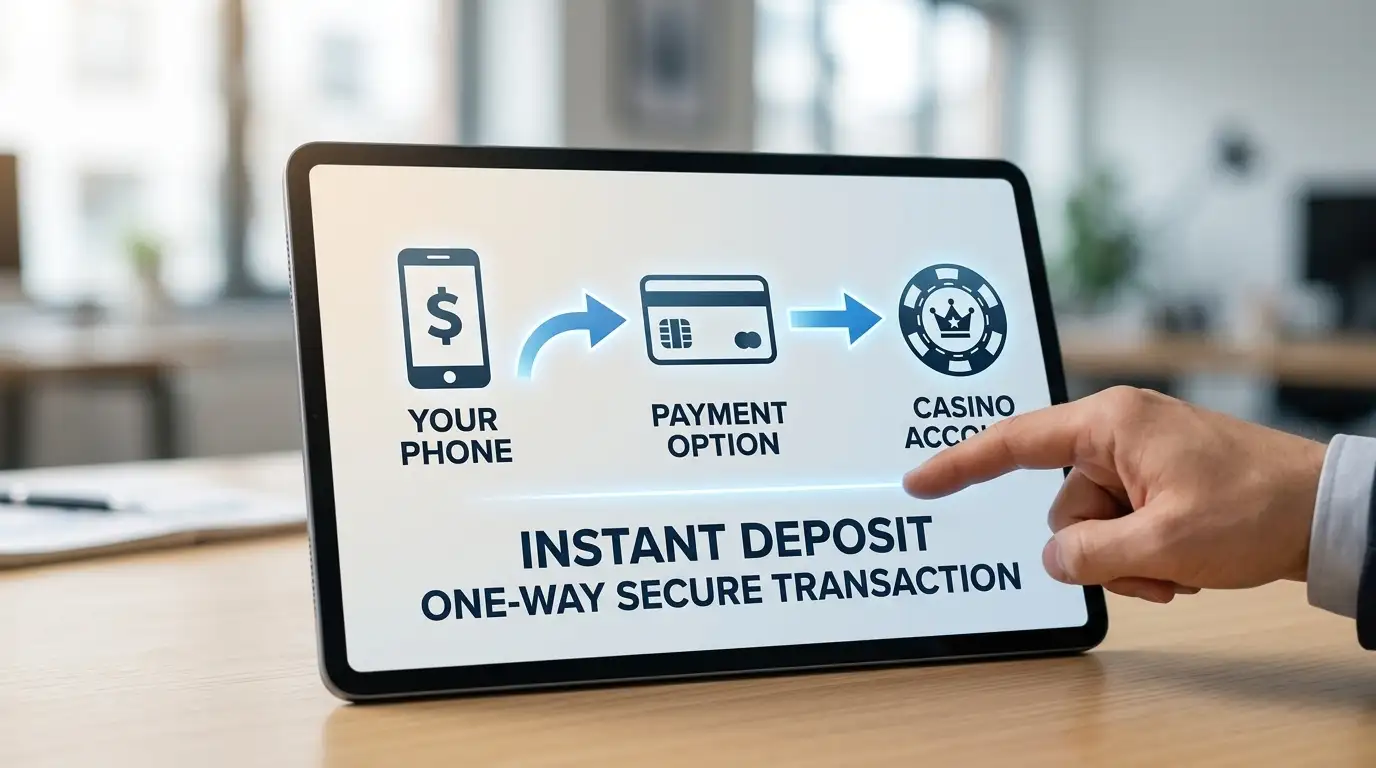
Phone accounts are debit-only structures. They can charge out — SMS fees, carrier billing, premium-rate services — but cannot receive inbound funds. The technical limitation is structural, not a temporary product gap. Your phone bill is a ledger of what you owe the network, not a balance that can be credited.
Even if the technical architecture supported inbound transfers, carrier billing is not designed for it. Paying winnings into phone accounts would turn phone credit into a wallet — depositing, withdrawing, cycling funds through the account — and that would bring payment-services and anti-money-laundering obligations that carrier billing was never built to meet.
This is why Open Banking methods are different. Pay by Bank options such as Trustly connect your bank account rather than your phone bill, so the same rails can carry withdrawals back to you. Fonix cannot. If you deposit via Fonix, you will need PayPal, Skrill, a debit card or bank transfer for cashout.
The asymmetry creates friction. Deposit via mobile billing: instant, no card details, one SMS confirmation. Withdraw: verify a second payment method, wait 24 to 48 hours (or 3 to 5 days at slower casinos), and answer any payment-ownership checks. The convenience advantage on the deposit side inverts on the withdrawal side.
Some players accept the trade-off. They value deposit simplicity more than withdrawal speed. Others find the friction untenable and switch to symmetric methods (PayPal, Skrill) that handle both directions. The choice depends on whether deposit convenience or withdrawal symmetry sits higher in your priorities.
Casinos cannot change this. It is not a policy they choose. The limitation is baked into carrier-billing infrastructure. If a casino advertises “deposit and withdraw via phone bill,” it is either misleading you or using imprecise language to describe a mobile-friendly Pay by Bank option, which is technically distinct from carrier billing.
Can I withdraw winnings back to my phone bill?
No. Carrier billing only works in one direction: your phone account can be charged, but it cannot receive winnings. You will need PayPal, Skrill, a debit card or bank transfer for withdrawals, so set one up and verify it before you need it. Pay by Bank options can carry winnings back to your bank account.
Slots and Mobile Top-Up: What You Need to Know
Slots dominate mobile-billing casino traffic. The payment method’s £30 transaction cap aligns with typical slots-session bankrolls. Deposit £20, spin through 100 rounds at £0.20 per spin, and the session is over. The pattern fits carrier-billing’s design constraints better than high-stakes table games or large sportsbook accumulators.
Casinos accepting mobile billing skew slots-heavy in their game libraries. IvyCasino, Oreels, Thor Slots, Amazon Slots, Wizard Slots, Crystal Slots — all position around reels catalogues. Live dealer exists but sits secondary. Sportsbook integration (Bet442, Funky Jackpot) is the exception, not the rule.
The method works identically across game types. Deposit £30 via mobile billing, and you can play slots, blackjack, roulette, or bet on football. The £30 cap does not restrict which games you access, only the deposit size. Slots players tend to deposit smaller amounts more frequently, which aligns with the cap. Table-game players who prefer £100 sessions find the cap restrictive.
Mobile-billing slots bonuses follow standard UKGC wagering rules: turnover requirements capped at 10x since 19 January 2026, online slot stakes capped at £5 per spin (£2 for 18–24-year-olds), game weighting (slots count 100%, table games 10% or excluded), time limits (7 to 30 days). The deposit method does not affect bonus terms. Deposit £10 via mobile billing or debit card, and the welcome offer applies identically.
One practical note: if you claim a slots bonus funded by a mobile-billing deposit and then attempt to withdraw before meeting wagering requirements, the withdrawal will be processed via your verified secondary method (debit card, PayPal), not your phone bill, and the casino will normally cancel the bonus and any winnings tied to it. Check the terms first: UK rules require operators to explain clearly what happens to bonus funds on withdrawal.
UKGC Licensing and PSA Regulation for Mobile Payments
Every casino accepting mobile payments in the UK must hold an active UKGC licence. The licence number appears in the footer of the operator’s website, verifiable on the UKGC public register. Jumpman Gaming Limited, for example, is account 39175; for Betable Limited and the other operators in this guide, check the number in the site footer against the register.
The PSA (Phone-paid Services Authority) regulated premium-rate services, including gambling deposits by phone bill, until February 2025, when its functions transferred to Ofcom. The PSA’s Code 15 continues to govern phone-paid services. Code 15 requires merchant registration, due diligence, pricing transparency, consent-to-charge standards, and customer-care obligations.
Fonix and other carrier-billing processors operate under Code 15. Casinos operate under UKGC licences. The two regulatory layers sit independently. A casino can hold a valid UKGC licence but still face payment-processing friction if its Fonix integration violates Code 15 (e.g., insufficient fee disclosure, misleading confirmation flows). Conversely, a payment processor can comply with Code 15 but route transactions for an unlicensed operator (illegal in the UK; the casino would be shut down).
UKGC rules require age and identity verification before you can deposit or gamble. Most casinos complete it electronically at sign-up; if that fails, you’ll be asked for an ID document and proof of address before the cashier unlocks, and larger spenders may later face source-of-funds questions. Mobile billing does not bypass any of this.
Remote Gaming Duty increased from 21% to 40% effective 1 April 2026. The tax hits operators, not players directly, but it compounds the cost structure that feeds into payment-processing fees. The £2.50 mobile-billing surcharge reflects processors passing merchant costs through to casinos, which pass them through to players. Betable Limited absorbs those costs; everyone else passes them along.
The PSA-to-Ofcom transition (February 2025) did not alter the deposit caps. £30 per transaction and a typical monthly ceiling of around £240 remain in force. Ofcom has not signalled plans to revise the caps as of 2026. The limits are treated as harm-minimisation measures, unlikely to increase without significant regulatory justification.
Do I need to verify my identity before making a phone bill deposit?
Yes. Since May 2019, UKGC rules require casinos to verify your age and identity before you can deposit by any method, including phone bill. Most checks happen electronically at sign-up in seconds. If they fail, you’ll be asked for photo ID and proof of address before the cashier unlocks.
Casino Deposit Methods UK 2026 – Compare Payment Options
Content created by the «Cashier Atlas» team