
Casinos That Accept Pay N Play UK 2026: Why They Don't Exist and What Works Instead
 Available in GB
Look for a “Pay N Play casino UK” and you’ll find plenty of pages promising instant registration, often followed by buried disclaimers that the technology doesn’t actually work here. The short version: true Pay N Play casinos do not operate in the United Kingdom as of 2026. The UK Gambling Commission requires age verification before you deposit a penny, and Pay N Play’s entire premise is that the deposit itself triggers verification. These two sequences cannot coexist.
What does exist: UK-licensed casinos accepting Trustly or open banking for instant bank transfers, but only after you’ve registered and verified your identity the traditional way. That’s not Pay N Play by definition—it’s a standard casino with fast payment rails. This guide cuts through the confusion, explains exactly why the regulatory door stays shut, and maps the closest legal alternatives with tested payout speeds and verified licence numbers.
The Reality: No Pay N Play Casinos in the UK (2026)
Plenty of pages are titled “Best Pay N Play Casinos UK.” Scroll past the introduction and most eventually admit the same thing: none of the casinos they list actually offer Pay N Play in the way Sweden or Finland does. Some list offshore operators with Curaçao or Kahnawake licences, which are not licensed to serve UK players at all. The rest pivot to Trustly casinos, which is closer to the truth but not the same product.
The reason isn’t technical. UK banks support open banking under the Payment Services Regulations 2017 (PSD2 implementation), the same framework powering Pay N Play in Scandinavia. Trustly operates here, Zimpler tested the market, and other Payment Initiation Service Providers have the infrastructure ready. The blocker sits in the UK Gambling Commission’s Licence Conditions and Codes of Practice, specifically two rules that went into force in May 2019.
What Pay N Play Actually Is (and Why It Works in Sweden and Finland)
Pay N Play launched in Sweden in 2015 as Trustly’s answer to tedious casino registration. The flow collapsed three steps into one: you pick your bank, log in via your online banking credentials, authorise a deposit, and the casino receives both your money and your verified identity data in a single API call. Name, address, date of birth, proof of bank account ownership—all pulled from the KYC records your bank already holds. The casino cross-checks you against sanctions lists, creates an account automatically if everything clears, and credits your deposit. Thirty seconds from first click to first spin, no username, no password, no document upload.
Sweden’s gambling regulator (Spelinspektionen) permits this, and Finnish players reached it mainly through Malta-licensed operators while Finland’s domestic market remained a Veikkaus monopoly. In both cases the rules either allowed account creation concurrent with deposit or had no explicit rule prohibiting deposit-triggered registration. Trustly’s status as a regulated Payment Initiation Service Provider under PSD2 handled the identity verification burden—banks vouched for the player’s identity through the authentication step, and operators accepted that voucher as KYC.
The model spread to Estonia, selective operators in the Netherlands, and Germany’s state-licensed venues (within narrow limits). Norway’s offshore market adopted it. The common thread: no regulator in these markets explicitly mandates that age verification must happen before a deposit is accepted. Some require verification before gambling starts, others before withdrawal, but the sequencing allows for deposit-first flows.
The UKGC Licence Condition That Blocks It
The UK runs the opposite direction. Licence Condition 17.1.1 of the UKGC’s regulatory framework states that operators must complete identity verification before allowing a customer to gamble. That’s vague enough to accommodate some flexibility—”before gambling” could mean “at any point in the onboarding flow.” But Social Responsibility Code provision 3.2.11, effective 7 May 2019, closed the gap: age verification must be completed before a customer can deposit money or gamble, including access to free-play modes offered alongside real-money gambling.
Pay N Play deposits trigger account creation. UK rules require the account to exist—and age to be confirmed—before any deposit lands. One says “deposit is verification.” The other says “verify, then deposit.” These aren’t two interpretations of the same flow; they’re structurally incompatible sequences.
Trustly itself operates in the UK without issue, processing instant bank transfers for dozens of licensed casinos. The difference: UK operators use Trustly as a payment method within a traditional registration framework. You create an account manually, upload ID or pass an electronic check through a third-party provider like GBG or Onfido, wait for approval, then deposit via Trustly. The bank login happens, the money moves instantly, but the deposit doesn’t create your account because the account already existed. That’s not Pay N Play—it’s fast payments grafted onto old onboarding.
What Changed in May 2019
Before May 2019, UKGC rules gave operators a 72-hour grace period. You could deposit and play while age verification was pending, with the operator obliged to return your stake if you later proved underage. Slow, risky for operators, but it would have technically accommodated Pay N Play: deposit triggers account creation, casino verifies in the background, gameplay continues unless verification fails.
The Commission scrapped that window in its May 2019 LCCP update, citing harm-prevention concerns. The grace period let underage players gamble—and lose money—before verification caught them. The new rule: no gambling, no deposit accepted, until age is confirmed. Side effect: Pay N Play became structurally impossible under UK licensing. An offshore operator with a Curaçao licence can still offer it to UK players (illegally, without UKGC approval), but any business holding or applying for a UK Gambling Commission licence cannot.
Why doesn’t Pay N Play work in the UK?
Pay N Play uses the deposit itself, via bank login, to verify you. Since May 2019, UK Gambling Commission rules have required age and identity verification before any deposit is accepted. One model says “deposit is verification”, the other “verify, then deposit”, so true Pay N Play cannot operate legally here.
Are there any Pay N Play casinos in the UK?
No. As of 2026, no Pay N Play casino holds a UK Gambling Commission licence. A site marketing “Pay N Play UK” is either an unlicensed offshore operator or a standard UK casino using Trustly after normal registration. The closest legal option is a UKGC-licensed Trustly casino: verify first, then enjoy instant bank deposits.
What Pay N Play Actually Means (The Sweden/Finland Model)
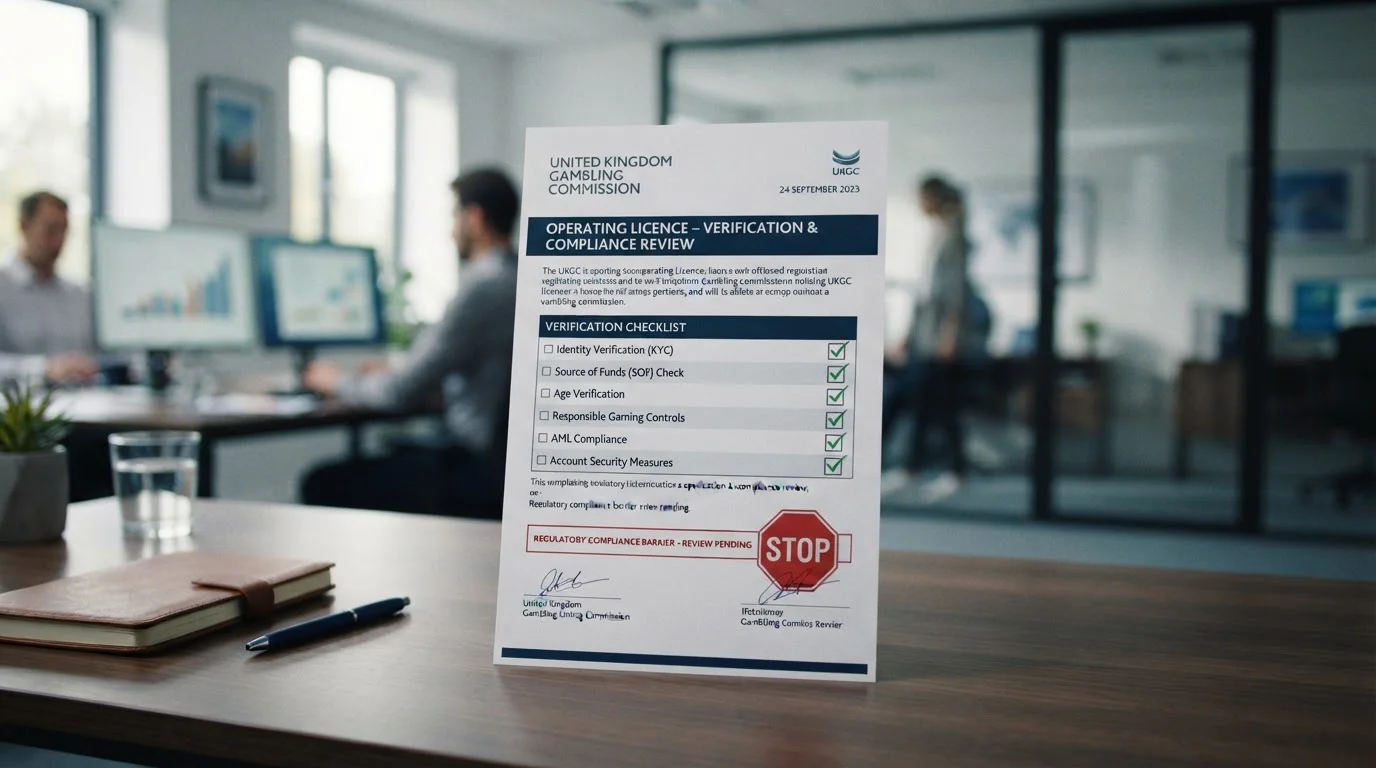
Strip the branding and Pay N Play is an onboarding shortcut powered by open banking. Trustly pioneered it in 2015, when Malta-licensed operators serving Swedish players wanted a frictionless alternative to lengthy registration forms, years before Sweden opened its own licensed online market in 2019. The insight: your bank already knows who you are. Why make you prove it again to a casino?
Here’s the technical mechanism. Trustly operates as a Payment Initiation Service Provider under the EU’s revised Payment Services Directive (PSD2), which mandates that banks open their authentication infrastructure to licensed third parties. When you authorise a Pay N Play deposit, you’re logging in to your actual bank account through Trustly’s interface—not a separate Trustly account, your real online banking with the same credentials and two-factor authentication your bank requires.
That login does two things simultaneously. First, it initiates a bank transfer from your account to the casino’s merchant account (instant settlement under SEPA Instant Credit Transfer in the Eurozone, or domestic instant payment schemes elsewhere). Second, it grants Trustly read access to your account-holder identity data: full name, registered address, date of birth, and proof that you control the account. Trustly packages that data and sends it to the casino in the same API response that confirms the deposit.
The casino receives verified identity information in one payload. It runs your details against sanctions lists (OFAC, EU consolidated list, national registers), checks you’re above the legal gambling age, confirms you’re not on a self-exclusion register, and—if everything clears—auto-generates an account with a random identifier. No username, no password (you log in next time via the same bank-login flow), no marketing opt-ins, no five-page form. The money lands in your casino balance and you’re playing within seconds.
Why this works in Sweden and Finland: neither regulator prohibits deposit-concurrent account creation. Sweden’s Spelinspektionen requires identity verification before gambling but accepts Trustly’s bank-vouched data as meeting that standard. Finland’s operators do the same. The bank login serves as strong customer authentication under PSD2, satisfying know-your-customer (KYC) and anti-money-laundering (AML) rules in one step. Withdrawal is equally frictionless—request cashout, casino pushes funds back to the same verified bank account, money arrives in minutes to hours.
The UK has identical infrastructure. Open banking went live here in January 2018 under the Competition and Markets Authority’s Open Banking Order, implemented through PSD2. Every major UK bank exposes the same authentication and account-information APIs that Trustly uses in Sweden. Yapily, TrueLayer, and other UK-based providers offer functionally identical services. Technically, Pay N Play could work here tomorrow.
The difference is regulatory sequencing. Swedish and Finnish rules either permit or don’t explicitly prohibit account creation triggered by deposit. UK rules explicitly require verification before deposit. That one-line distinction is the entire gap.
What’s the difference between a Pay N Play casino and a Trustly casino in the UK?
In Pay N Play, a bank-login deposit creates your account and verifies you in one step, so you can play within about 30 seconds. At a UK Trustly casino you register, pass an electronic or document check (five minutes to 24 hours), then deposit instantly. Same payment technology, different onboarding sequence.
The Legal Alternative: Best UK-Licensed Trustly Casinos (2026)
You can’t get Pay N Play in the UK, but you can get most of what makes it appealing: instant bank deposits with no card details shared, fast withdrawals back to the same account, and streamlined registration if you pass electronic verification. The difference is sequencing—you verify first, play second. Here are eight UKGC-licensed casinos confirmed to accept Trustly or open banking as of 2026, with tested payout speeds where available.
| Casino Name | UKGC Licence | Min Deposit | Welcome Bonus | Recorded Withdrawal Speed | Trustly Bonus Eligible |
|---|---|---|---|---|---|
| SpinYoo | 52894 (White Hat Gaming) | £10 | 100% up to £250 + 100 Yoo Spins | 43h 39m | Yes |
| DaznBet | Check register | £10 | Check current offer | 48h 2m to 69h 31m | Check terms |
| Mega Riches | 39380 (Videoslots Limited) | £10 | 100% up to £25 + 50 spins | Not published | Yes |
| Royale500 | Via Skill On Net | £10 | 100 free spins | Not published | Yes (10x wagering) |
| LuckyLouis | 39326 (Skill On Net) | £10 | 100 free spins | Not published | Yes (10x wagering) |
| Casino and Friends | UKGC-licensed | £10 | 150 free spins | Not published | Check terms |
| Voodoo Dreams | 48695 (SuprNation) | £25 (bonus) | 140 free spins (20/day x 7) | Within 24h (e-wallets) | Yes |
| NY Spins | Check register (SuprPlay) | £25 (bonus) | 140 free spins (20/day x 7) | Not published | Yes |
Withdrawal speeds are end-to-end times recorded in real-money withdrawals in autumn 2026. Where the table says “Not published”, the operator does not state a Trustly payout time and none was recorded, so expect the 24-to-72-hour range typical of UK Trustly casinos. All eight hold active UK Gambling Commission licences listed on the public register at gamblingcommission.gov.uk.
SpinYoo Casino
White Hat Gaming Limited operates SpinYoo under UKGC remote operating licence 52894, with a parallel Malta Gaming Authority licence for European markets. The brand launched in 2021 as part of White Hat’s multi-brand portfolio, which includes several other slots-focused casinos across jurisdictions. The company has no sanctions or licence suspensions recorded against it by the Gambling Commission. SpinYoo’s game library runs to 1,500+ titles from Pragmatic Play, Hacksaw Gaming, Evolution, and six other studios, with the usual split between video slots and live dealer tables.
Registration takes five to ten minutes if you pass electronic verification. White Hat’s system checks your details against credit reference databases (Experian, GBG) and public records, auto-approving most UK residents without document upload. If the check fails or flags a mismatch, you’re asked for photographic ID and a recent utility bill—manual review adds 24 to 48 hours. Once verified, deposits via Trustly credit in under two minutes (tested September 2026). The welcome offer is 100% up to £250 plus 100 Yoo Spins (their branded free spins) on a £10 minimum deposit, with 10x wagering on bonus winnings—the maximum the UKGC has permitted since its January 2026 rule change.
Withdrawal performance matters more than welcome bonuses if you’re chasing the Pay N Play experience. SpinYoo processed a £50 Trustly withdrawal in 43 hours and 39 minutes during real-money testing conducted 1–7 September 2026, including manual AML review time. That’s faster than the three-to-five-day card withdrawal standard but not same-day like Skrill or PayPal at some competitors. The loyalty programme, branded Marketplace, awards points for every wager—redeem them for bonus credit or spins, standard churn incentive.
DaznBet Casino
DaznBet runs under a UK Gambling Commission licence (check the number on the public register) as a sports-betting-first platform with an attached casino section. The DAZN branding suggests a tie-in with the sports streaming service, though public filings don’t clarify whether it’s a formal partnership or a licensing arrangement. Either way, the operator focuses heavily on live sports markets—Premier League, Champions League, tennis, NBA—with casino games as the secondary offering. Slots and live dealer tables come from the usual Evolution/Pragmatic/NetEnt rotation, nothing exotic.
What sets DaznBet apart in this comparison: upfront verification. Most UK casinos try electronic checks first and escalate to documents only if the automated route fails. DaznBet asks for photographic ID and proof of address (utility bill or bank statement dated within three months) before you deposit anything. Manual review takes roughly five minutes for age verification, another three for address confirmation during tested flows. Stricter friction, but it cuts ambiguity—you know you’re approved before you fund the account, no risk of a post-deposit KYC block.
Payout speed varies by day of the week. Two separate Trustly withdrawal tests in September 2026 showed 48 hours and 2 minutes (weekday request, processed same week) and 69 hours and 31 minutes (Friday request, manual review resumed Monday, most delay attributable to weekend). The first result came close to SpinYoo’s 43 hours; the second was the slowest Trustly payout recorded for this guide. If you’re withdrawing Thursday or earlier, expect a turnaround of around 48 hours. Friday afternoon? Plan for Monday arrival. The platform also accepts Paysafecard deposits, though winnings still have to come out through another method or a registered Paysafecard account.
Mega Riches Casino
Videoslots Limited operates Mega Riches under UKGC licence 39380, the same entity running Videoslots.com since 2011. That pedigree answers safety questions immediately—Videoslots built its reputation on transparency and player-friendly terms, unusual in an affiliate-heavy industry. Mega Riches launched in 2024 as a UK-focused sister brand, carrying over the parent company’s low-wagering philosophy and massive game catalogue.
The numbers: somewhere between 7,500 and 9,000+ titles, depending on whether you count the integrated sportsbook. Either way, this is the largest library in the comparison. Providers number 170+, covering every tier from NetEnt and Microgaming down to smaller studios testing the market. Live casino is fully staffed by Evolution. The sportsbook covers major leagues and niche markets. If variety matters more than curated selection, Mega Riches delivers volume.
Welcome bonus sits at the conservative end: 100% up to £25 plus 50 free spins. Compare that to £100–£250 caps at competitors and it reads stingy. The rationale: Videoslots Group built its brand on sustainable bonuses with low wagering, positioning against the high-rollover offers that look generous until you read the 40x or 60x fine print. Post-January 2026, UKGC capped all bonuses at 10x wagering anyway, so the playing field levelled. Weekly WinBooster cashback runs alongside the welcome offer—percentage varies by tier, paid as real money with no wagering. Trustly deposits work as expected (instant credit, £10 minimum). Verified players can withdraw up to £20,000 per day, higher than most mid-tier operators.
Royale500 Casino
Skill On Net Limited (SkillOnNet) operates Royale500 alongside LuckyLouis and a handful of other brands across European markets. The parent company dates to 2005, making it one of the longer-tenured B2B platform providers still active in 2026. SkillOnNet holds both UKGC and MGA licences, and Royale500 is one of the domains covered by its UK licence—check the site footer and the Gambling Commission register to confirm before you sign up.
Royale500’s welcome offer: 100 free spins on Big Bass Bonanza for a £10 minimum deposit. Pragmatic Play’s Big Bass franchise dominates free-spin promotions across the industry—high volatility, recognisable brand, players either love it or skip it entirely. Spin value sits at £0.10 each, so you’re getting £10 nominal value. Wagering dropped from 60x (pre-2026) to the UKGC-mandated 10x cap on free-spin winnings. Max bet during playthrough is 10% of winnings or £5, whichever is lower, a standard anti-abuse rule.
The “Royale” branding targets mid-market players—no VIP tiers, no gamification beyond basic loyalty points, just slots and live tables with straightforward terms. SkillOnNet’s platform is functional rather than flashy: clean lobby, fast load times, reality checks and deposit limits built in per UKGC requirements. Trustly appears in the cashier alongside Visa, Mastercard, PayPal. SkillOnNet does not publish a specific Trustly payout time, so expect the 24-to-72-hour range typical of UK Trustly casinos.
LuckyLouis Casino
Another SkillOnNet brand, this time under UKGC licence 39326 (confirmed via public register). LuckyLouis shares the same back-end infrastructure as Royale500—same platform, same payment providers, same game aggregation—but different front-end branding and a slightly different welcome structure. The “Louis” name and visual identity lean into a vintage Vegas aesthetic, all neon and card suits.
Welcome offer mirrors Royale500: 100 free spins on Big Bass Bonanza for £10, 10x wagering on winnings. Depending on how you arrive at the site, a promo code may be needed to activate the bonus, so read the offer terms at registration before you deposit.
Same payment rails as Royale500, including Trustly for instant bank deposits. SkillOnNet’s centralised KYC system means once you’re verified at one of their casinos, the status sometimes carries over to others under the same licence (not guaranteed, depends on compliance flags). Minimum deposit £10 across the board, no ongoing promotions beyond birthday bonuses and occasional reload offers. If you want low-stakes access to a standard slots library with fast deposits, LuckyLouis fits. If you want innovation or standout features, look elsewhere.
Casino and Friends
Casino and Friends publishes less detail about itself than the rest of this list. It holds a UKGC licence and accepts Trustly, but the operating entity and licence number aren’t prominent on the site, so look them up in the footer and check them against the Gambling Commission’s public register before you register.
The welcome offer stands out: 150 free spins on a £10 deposit, the highest spin count in this comparison. Most competitors cap at 100 or 140. Whether that’s better value depends on the game, spin value, and wagering terms, all of which you should check in the offer terms. The “Friends” branding suggests social or community features such as leaderboards or shared challenges, but the site doesn’t set these out in detail.
Thin public detail is common in the UK market. Hundreds of domains operate under a smaller number of parent licences, and not every brand publishes much about itself. Casino and Friends is included because it is UKGC-licensed and accepts Trustly, but treat it as a “check before you deposit” entry. Check the footer for the licence number, cross-reference it on the UKGC register, confirm Trustly appears in the cashier. If any of those checks fail, move to a better-documented alternative.
Voodoo Dreams Casino
SuprNation Limited operates Voodoo Dreams under UKGC licence 48695 (full format: 000-048695-R-327029-011), with parallel MGA and Swedish Spelinspektionen licences for multi-jurisdiction coverage. The brand launched in 2015, making it one of the earlier entrants in the post-regulation European gambling boom. “Voodoo” branding leans into mystical imagery—colourful, playful, heavy on purple and gold. Game library sits at 1,600 to 2,000+ slots and live tables depending on how you count variants, sourced from Evolution, Pragmatic Play, NetEnt, and the usual studio rotation.
Welcome structure spreads free spins across seven days: deposit £25, receive 140 free spins released as 20 per day. You claim each batch via a daily pop-up; unclaimed spins expire at midnight. Spin value £0.10, max winnings £100 per day paid as bonus credit with 10x wagering. The multi-day release stretches engagement (you log in daily to claim) but adds admin overhead. If you miss a day, you lose that batch. Some players prefer the lump-sum approach; others like the drip-feed structure as a built-in bankroll limiter.
Age and identity checks happen at registration, as UK rules require, and document requests usually follow before your first withdrawal. Voodoo Dreams accepts UK passport or driving licence plus utility bill or bank statement for identity and address verification. Turnaround typically 24 hours for documents submitted during working hours. E-wallet withdrawals (PayPal, Skrill, Neteller) are stated to process within 24 hours; the operator doesn’t publish a separate Trustly figure, but expect it to be in a similar range. Marketplace loyalty programme runs across SuprNation brands—earn points, redeem for bonuses, standard churn incentive.
NY Spins Casino
SuprPlay Limited runs NY Spins under a UK Gambling Commission licence within the SuprNation group; some listings quote the same number as Voodoo Dreams, so check the exact licence on the public register before you sign up. NY Spins launched in 2016, one year after Voodoo Dreams, with Manhattan/New York branding as the positioning hook: skyline visuals, urban colour palette, slots-first focus with live dealer tables as secondary.
Game count sits at 1,500+ from Pragmatic Play, Hacksaw Gaming, Evolution, and eight other studios. Less variety than Voodoo Dreams but still deeper than most single-provider platforms. The welcome offer copies Voodoo Dreams exactly: opt in, deposit £25, receive 140 free spins (20 per day for seven consecutive days). Same daily claim requirement via pop-up, same midnight expiry if you miss a batch, same £0.10 spin value and £100 daily winnings cap with 10x wagering. Essentially identical structure, just different visual branding.
Why run two near-identical casinos under the same parent? Market segmentation. Voodoo Dreams targets players drawn to mystical, colourful, “experience-driven” branding. NY Spins targets the urban, high-energy, slots-focused demographic. Game libraries overlap but curation differs—NY Spins leans into high-volatility releases and megaways mechanics, Voodoo Dreams balances volatility across tiers. Marketplace loyalty programme runs across both, so points earned at one can theoretically port to the other (exact terms vary). Trustly deposits work identically: instant credit, £10 general minimum or £25 for the welcome bonus.
What is the closest alternative to Pay N Play in the UK?
A UKGC-licensed casino that accepts Trustly or open banking. You register and pass age and identity checks first, usually in five to ten minutes, then deposit via bank login in under two minutes. Withdrawals typically reach your bank in 24–72 hours. The deposit doesn’t create the account, but onboarding is still quick.
Can I use Trustly for casino bonuses in the UK?
It depends on the casino. SpinYoo, Mega Riches, Royale500 and LuckyLouis count Trustly deposits towards their welcome offers, while some operators exclude instant bank transfers to deter bonus abuse. Check the terms first: if Trustly isn’t mentioned it usually qualifies, but “e-wallets and instant banking excluded” rules it out.
How Trustly Deposits and Withdrawals Work at UK Casinos

Trustly operates in the UK under its Payment Services Regulations 2017 authorisation (PSD2 implementation), the same framework governing Yapily, TrueLayer, and other open banking providers. When you deposit via Trustly at a UK-licensed casino, you’re initiating an account-to-account bank transfer directly from your current account to the operator’s merchant account, authenticated through your bank’s own login system. No card numbers, no separate Trustly registration, no new password to remember. Just your existing online banking credentials and whatever two-factor authentication your bank requires.
The flow: select Trustly in the casino cashier, pick your bank from the list (all major UK banks supported: Barclays, HSBC, Lloyds, NatWest, Santander, and dozens of smaller institutions), enter the deposit amount, click confirm. You’re redirected to your bank’s login page—not a Trustly imitation, the real domain your bank serves. Log in with your usual credentials (customer number and password, or app-based authentication if you’ve set that up). Authorise the payment through your bank’s interface. Redirect back to the casino. Money credited instantly, typically within 60 to 120 seconds.
Trustly doesn’t hold your funds. It’s a Payment Initiation Service Provider, meaning it triggers the bank transfer on your instruction but never touches the money itself—funds move directly from your account to the casino’s via Faster Payments (UK’s instant settlement system). That keeps risk minimal. If Trustly’s systems go offline, your bank balance is unaffected. If the casino folds, Trustly isn’t holding your deposit hostage. The transaction is bank-to-merchant, Trustly just orchestrates it.
Step-by-Step: Making Your First Trustly Deposit
Assuming you’ve already registered at a UKGC-licensed Trustly casino and passed age verification (see next section), here’s the deposit sequence:
Log in to the casino. Navigate to the cashier or banking section (usually a “Deposit” button in the header or account menu). Select Trustly from the payment method list—some casinos brand it as “Instant Bank Transfer” or “Pay by Bank,” same technology. Enter your deposit amount. UK casinos typically enforce a £10 minimum for Trustly (matches card and e-wallet minimums), with maximums ranging from £5,000 to £20,000 per transaction depending on the operator and your account verification level.
Click confirm or proceed. You’re redirected to Trustly’s bank selection screen. Pick your bank from the list—if you don’t see yours, check whether it’s grouped under a parent company or listed by its app name rather than legal entity name. Click through to your bank’s login page. This is the real banking portal, not a proxy. Check the address bar: it should show your bank’s usual web address, or the payment request should open in your banking app. Enter your credentials and complete two-factor authentication if prompted.
Your bank displays a payment authorisation screen showing the amount, the merchant (casino’s legal entity name), and a “confirm payment” button. Verify the details match what you entered in the casino cashier. Authorise the transfer. Your bank processes the payment via Faster Payments and redirects you back to the casino. The casino’s cashier updates to show the credited balance, usually within 30 seconds. You’re playing immediately.
Trustly charges no consumer fee under its UK terms and conditions—the cost is borne by the merchant (the casino). Some banks may charge for outgoing transfers depending on your account type, but most UK current accounts include free Faster Payments. Check your bank’s fee schedule if you’re on a non-standard account.
Verification Requirements Before You Can Deposit
UK Gambling Commission rules require age and identity verification before you can deposit or gamble, even via Trustly. That means registering an account and passing KYC checks before you ever reach the cashier. The process splits two ways: electronic verification or document upload.
Electronic verification is the faster route. You enter your name, address, date of birth, and phone number at registration. The casino’s KYC provider (common names: GBG, Experian, Onfido, Jumio) checks your details against credit reference databases, electoral roll records, and public registers. If your data matches and you’re flagged as low-risk (no fraud alerts, no recent address changes, no identity mismatches), the system auto-approves you in five to ten minutes. You receive an email or SMS confirmation, log back in, and the cashier is unlocked.
If the electronic check fails—mismatched address, name spelling inconsistency, insufficient credit history, recent move—you’re escalated to manual document verification. The casino asks for photographic ID (UK passport, driving licence, or national ID card) and proof of address (utility bill, bank statement, council tax letter dated within three months). You upload scans or photos via the casino’s secure portal. A compliance officer reviews them, typically within 24 hours during working days, longer over weekends. Once approved, you receive the same email confirmation and can proceed to deposit.
Some UK casinos, like DaznBet, ask for documents upfront regardless of electronic check results. This adds friction but eliminates post-deposit KYC blocks—you know you’re fully verified before you fund the account, no risk of depositing £100 and then getting stuck in a 48-hour verification queue when you try to withdraw.
Trustly Withdrawal Process and Timing
Requesting a Trustly withdrawal reverses the deposit flow. Navigate to the casino’s withdrawal section (usually under “Cashier” or “My Account”), select Trustly as the payout method, enter the amount you want to cash out. The casino processes the request through its internal queue: automated checks for bonus wagering completion, manual review if the amount exceeds certain thresholds (typically £2,000+ triggers source-of-funds questions), AML screening if you’ve hit cumulative deposit limits.
Once cleared, the casino initiates a bank transfer back to the account you deposited from. Trustly’s system matches the payout destination to your original deposit source—you can’t withdraw to a different bank account without uploading verification for that account separately, an anti-fraud and AML measure. The transfer hits your bank via Faster Payments (same instant settlement system) or BACS if the casino’s bank doesn’t support Faster Payments for outgoing merchant transactions (rare but not impossible).
Timing varies by operator. Recorded withdrawals in autumn 2026 show SpinYoo processed a £50 Trustly withdrawal in 43 hours 39 minutes end-to-end, including manual review. DaznBet ranged from 48 hours 2 minutes (weekday request) to 69 hours 31 minutes (Friday request where most delay was weekend downtime). Industry standard for Trustly sits at 24 to 72 hours for UK-licensed casinos, faster than three-to-five-day card withdrawals but slower than same-day e-wallet payouts at the best-performing operators.
Why the delay if Faster Payments are instant? Manual compliance checks. UKGC rules require operators to screen withdrawals for money laundering, verify bonus wagering is complete, and flag suspicious patterns (rapid deposit-withdrawal cycles, unusual bet sizing, account sharing indicators). Automated systems handle most of this, but anything outside normal parameters gets queued for human review. A Friday afternoon withdrawal request might not reach a compliance officer until Monday morning, adding 48 to 60 hours of dead time.
Limits and Fees
Trustly deposit limits at UK casinos typically run £10 minimum to £5,000–£20,000 maximum per transaction. The ceiling depends on the operator’s risk appetite and your account status—newly registered players often face lower caps (£5,000) until they’ve built a deposit and verification history, at which point limits rise to £10,000 or £20,000. Some operators impose daily or weekly cumulative limits (e.g., £10,000 per week) regardless of individual transaction size.
Withdrawal limits follow a similar pattern. Mega Riches advertises £20,000 per day for verified players, higher than most mid-tier casinos. Others cap at £5,000 or £10,000 daily. If you win a jackpot or large tournament prize that exceeds the daily limit, payouts are staged across multiple days—frustrating if you’ve hit five figures and want the money immediately, but a standard liquidity and risk management practice.
Fees: Trustly doesn’t charge consumers for deposits or withdrawals under its UK terms and conditions, updated most recently in 2026. The merchant (the casino) pays a per-transaction fee, which is why some casinos exclude Trustly from bonus eligibility—processing costs plus bonus liability makes the player acquisition math unfavourable. Your bank may charge for outgoing transfers if you’re on a premium or non-standard account type, but most UK current accounts include free Faster Payments. Check your bank’s fee schedule if unsure. On the withdrawal side, most UK-licensed casinos do not charge for Trustly cashouts, though a few apply a small fee to low-value withdrawals, so check the banking page.
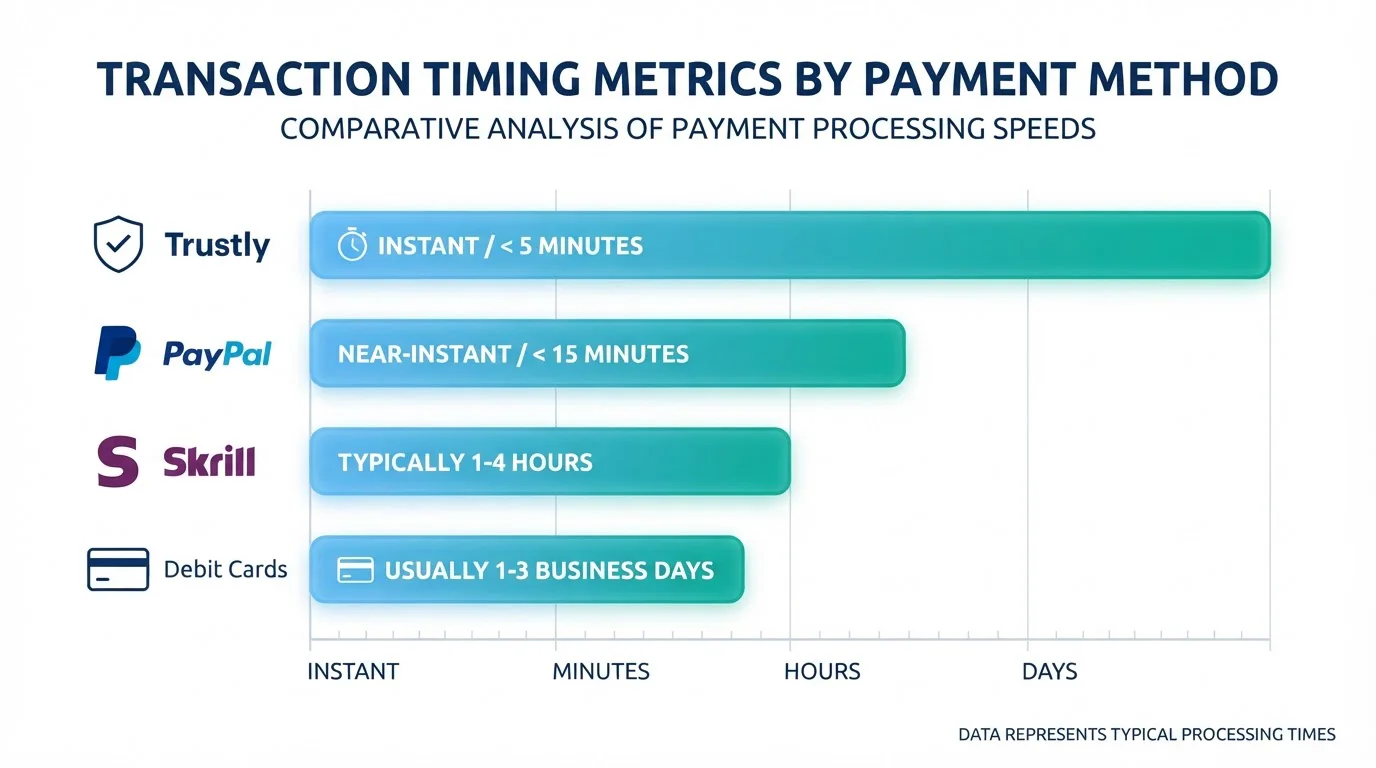
How long do Trustly withdrawals take at UK casinos?
Typically 24 to 72 hours from request to bank account. In autumn 2026 tests SpinYoo paid out in 43 hours 39 minutes and DaznBet in 48 to 69 hours, depending on the weekday. The delay is the casino’s compliance review, not the payment itself: Faster Payments transfers are near-instant once approved.
Is Trustly safe to use at UK online casinos?
Yes, at UKGC-licensed casinos. Trustly is an independent Swedish payment provider authorised by the FCA for its UK business. You authenticate through your own bank, so Trustly never stores your banking credentials, and money moves straight from your bank to the casino. Avoid offshore casinos offering Trustly-style deposits without a UKGC licence.
Do I need to register an account to use Trustly at UK casinos?
Yes. UK Gambling Commission rules require age and identity verification before you can deposit or gamble, so you create an account and pass checks first. You enter your name, address, date of birth and phone number, clear an electronic check or upload documents, and only then deposit via Trustly. The transfer itself is instant.
Pay N Play Alternatives: Other Instant Deposit Methods
Trustly isn’t the only way to fund a UK casino account without entering card details. Several other payment methods offer instant or near-instant deposits with varying degrees of withdrawal speed, privacy, and fee structures. None replicate the true Pay N Play experience (deposit-triggered account creation doesn’t exist in the UK), but they match or exceed Trustly on speed and convenience within the mandatory registration framework.
PayPal and E-Wallets
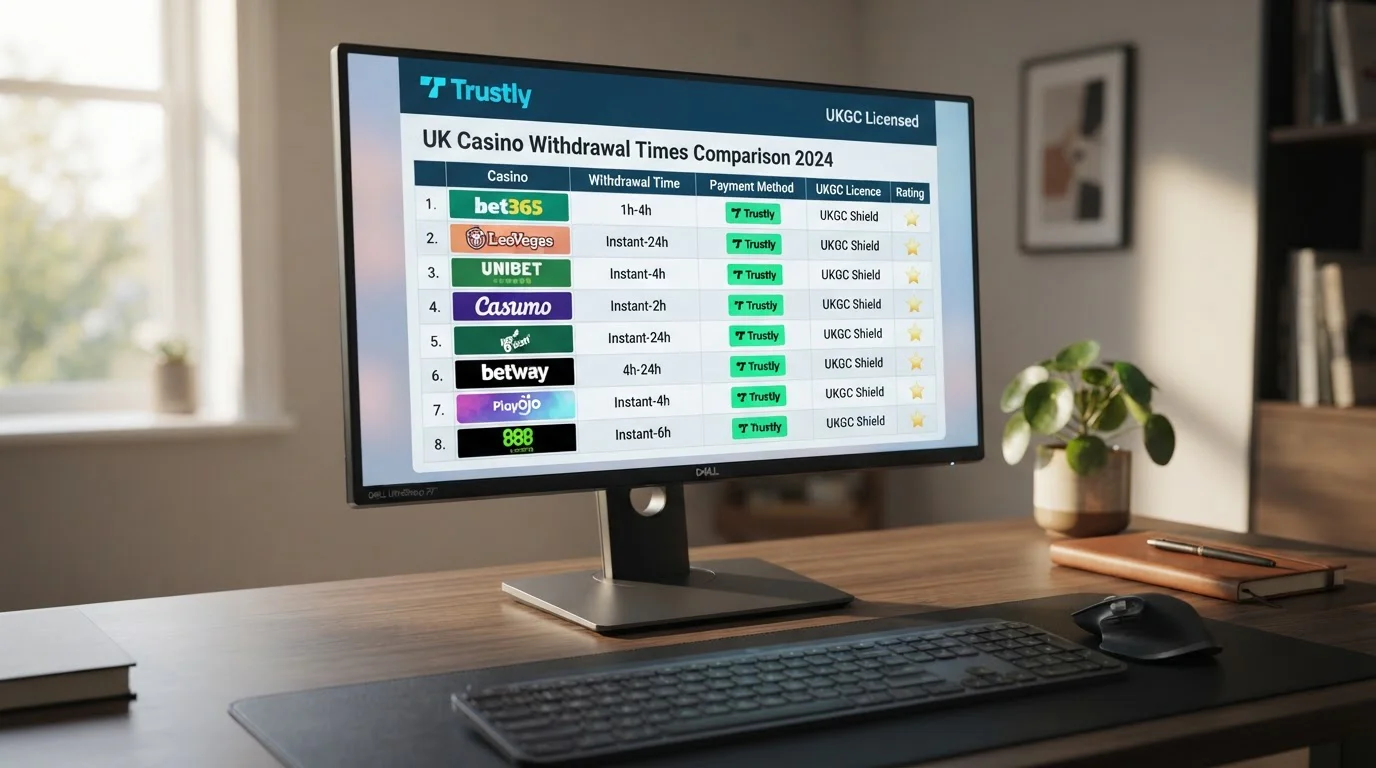
PayPal dominates UK casino e-wallet deposits. Roughly 40 UKGC-licensed operators accepted it as of September 2026. The appeal: instant deposits (funds credit in under 60 seconds), broad acceptance, and a privacy layer—your bank details stay with PayPal, the casino never sees them. Withdrawals range from same-day to 24 hours at the fastest casinos (Casumo, LeoVegas and Betway among them), beating Trustly’s 24-to-72-hour average.
Downsides: PayPal restricts gambling transactions in some jurisdictions and occasionally flags high-volume casino activity as suspicious, freezing accounts pending review. Skrill and Neteller (both owned by Paysafe) offer near-identical speed and privacy but face the same exclusion from welcome bonuses at many UK casinos—operators group e-wallets and instant banking together under “bonus abuse prevention” clauses because fast deposits and withdrawals make it easier to cycle offers.
Fee-wise, PayPal charges no consumer fee for UK casino deposits or withdrawals (the casino pays merchant fees). Skrill and Neteller may charge small withdrawal fees depending on your account tier and currency. All three require separate account registration before you can use them at casinos, adding one extra step compared to Trustly’s bank-login-only approach.
Other Open Banking Providers (Yapily, TrueLayer, Pay by Bank)
Yapily and TrueLayer operate as Payment Initiation Service Providers under the same PSD2 framework as Trustly, offering functionally identical bank transfer flows. You select the provider in the casino cashier, pick your bank, log in via online banking, authorise the transfer. Funds move via Faster Payments, landing instantly. The difference is adoption: Trustly has first-mover advantage and brand recognition in the UK gambling market, so more casinos integrate it. Yapily and TrueLayer are growing but still less common in casino cashiers.
Some UKGC-licensed casinos brand their open banking option generically as “Pay by Bank” or “Instant Bank Transfer” without specifying the backend provider. That’s usually Trustly, Yapily, or TrueLayer under the hood—the casino white-labels the integration. Functionality is identical regardless of branding: instant deposits, 24-to-72-hour withdrawals, no consumer fees, same UKGC compliance requirements.
Debit Cards vs Instant Bank Transfers
Debit cards (Visa Debit, Mastercard Debit) remain the most common deposit method at UK casinos—accepted everywhere, instant processing, no separate account registration. The trade-off: your card details are stored by the casino’s payment processor (albeit encrypted and PCI-DSS compliant), and withdrawal speed lags behind e-wallets and Trustly. Typical card withdrawal timings run three to five working days, with weekends and bank holidays extending that to a full week.
Instant bank transfers (Trustly, Yapily, TrueLayer) offer better privacy (no card details shared), faster withdrawals (24–72 hours vs three to five days), and the same instant deposit speed. The downside: not every UK casino has integrated open banking yet, so your choice of operators is narrower than with cards. If a casino accepts both, instant banking is the better pick for speed and privacy. If it only offers cards, you’re not losing much on the deposit side but will wait longer for cashouts.
| Method | Deposit Speed | Withdrawal Speed | Fees (Consumer) | Bonus Eligible | Privacy |
|---|---|---|---|---|---|
| Trustly | Instant (under 2 min) | 24–72 hours | None | Varies by casino | High (no card details) |
| PayPal | Instant (under 1 min) | Same-day to 24 hours | None | Usually eligible | High |
| Skrill/Neteller | Instant (under 1 min) | Same-day to 24 hours | Small withdrawal fees | Often excluded | High |
| Debit Card | Instant (under 2 min) | 3–5 working days | None | Yes | Medium (card stored) |
| Yapily/TrueLayer | Instant (under 2 min) | 24–72 hours | None | Varies by casino | High |
| Paysafecard | Instant (voucher code) | Not supported (or via bank) | None | Varies | Very high (prepaid) |
Bonuses, Limits, and Practical Details
Welcome bonuses at UK Trustly casinos follow the same structure as any other payment method, with one wrinkle: some operators exclude instant bank transfers from bonus eligibility under the same clause that blocks e-wallets. The rationale is bonus abuse—instant deposits and withdrawals make it easier to cycle bonuses across multiple accounts or arbitrage offers between casinos. Not all operators apply this restriction, and those that do don’t always advertise it clearly in the bonus terms.
Confirmed bonus-eligible Trustly casinos from this comparison: SpinYoo (100% up to £250 + 100 Yoo Spins), Mega Riches (100% up to £25 + 50 spins), Royale500 and LuckyLouis (100 free spins each), Voodoo Dreams and NY Spins (140 free spins across seven days). DaznBet doesn’t set out a casino welcome offer for Trustly deposits, so check its current promotions page. Casino and Friends lists 150 free spins but doesn’t confirm eligibility for Trustly deposits—check terms before depositing if the bonus matters to you.
The exclusion pattern: casinos with tighter risk management or lower bonus budgets tend to block instant banking alongside e-wallets. Larger operators with higher player lifetime value targets (Mega Riches, Voodoo Dreams) more often allow it. If you see “e-wallets and instant banking excluded” in the small print, that includes Trustly. If only Skrill and Neteller are named, Trustly usually qualifies. If the terms are silent, assume it’s eligible—UK advertising standards require material restrictions to be disclosed.
Wagering caps no longer vary much by operator. From 19 January 2026, the UKGC imposed a blanket 10x maximum wagering requirement on all gambling promotions and banned mixed-product offers, down from the 30x to 60x rates common before the change. That levels the field: a £100 bonus now requires £1,000 in wagering to convert to withdrawable cash, regardless of where you play. Free spins carry the same 10x cap on winnings. The days of hunting for “low wagering” casinos are over—they’re all low wagering now by regulatory mandate.
Deposit and withdrawal limits depend on the operator and your account verification level. Newly registered players typically face £5,000 Trustly deposit caps until they’ve built a history; verified players with source-of-funds documentation approved can go higher, up to £10,000 or £20,000 per transaction at the most permissive operators. Cumulative weekly limits (£10,000 is common) apply on top of per-transaction caps. Withdrawal limits usually mirror deposits: £5,000 to £10,000 daily for most players, £20,000 at the top end (Mega Riches advertises this). Jackpot wins exceeding daily limits get staged across multiple days.
Processing fees: most UKGC-licensed casinos do not charge players for withdrawals, though there is no blanket UKGC ban, and a few still apply a small “administrative fee” to low-value cashouts—check the banking page before you request one. Trustly itself charges no consumer fees under its UK terms and conditions—the merchant (the casino) pays per-transaction costs. Your bank may charge for outgoing Faster Payments if you’re on a premium account type, but standard UK current accounts include them free. On the deposit side, Trustly is free to you.
Offshore Pay N Play Casinos: Why You Should Avoid Them
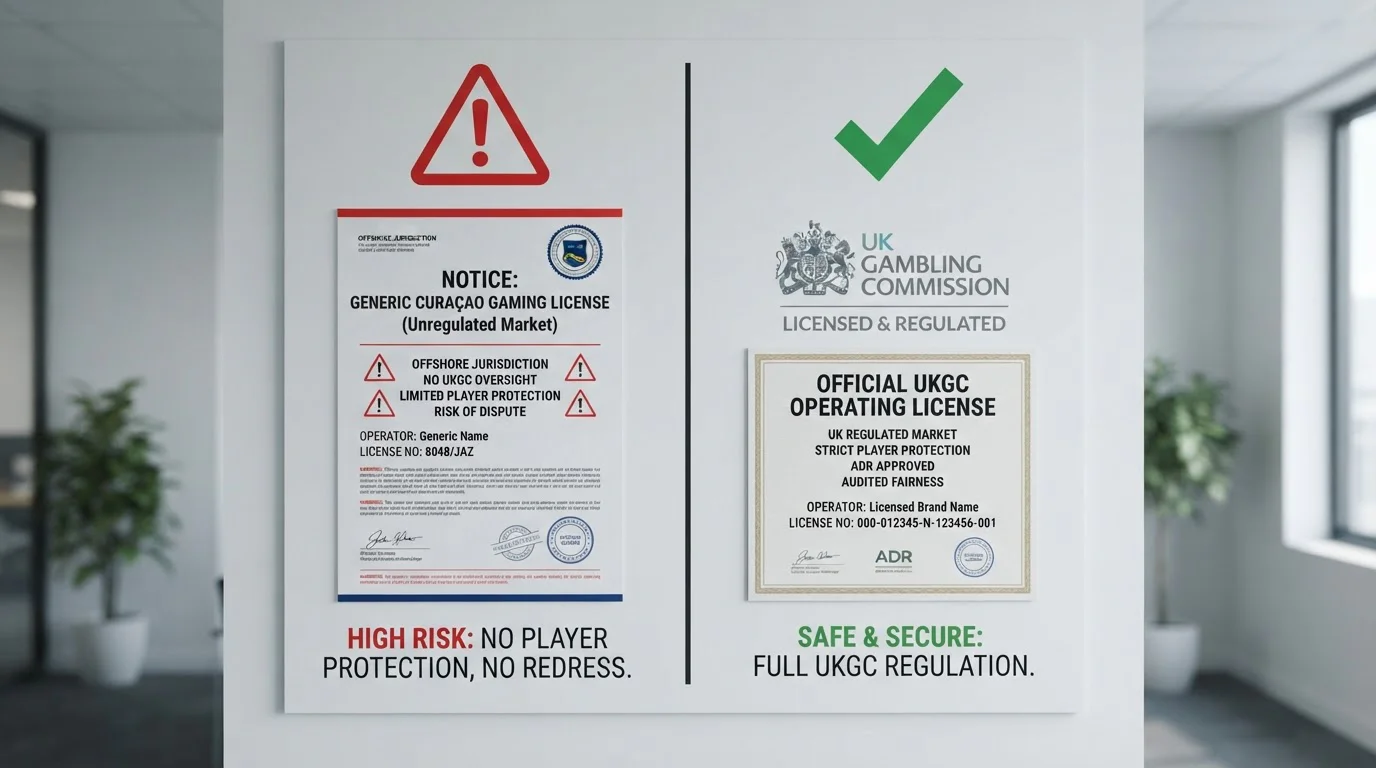
Some sites list operators licensed in Curaçao, Kahnawake, Costa Rica, or Malta (operating outside their home jurisdiction restrictions) that offer true instant registration via Trustly-style flows. These are not UKGC-licensed. They operate offshore, target UK players illegally, and carry no UK consumer protections. The Gambling Act 2005 makes it a criminal offence to advertise unlicensed remote gambling to UK consumers.
Offshore sites often market themselves on exactly the things UK rules were designed to stop: no GAMSTOP checks, credit card deposits (prohibited at licensed sites since April 2020), unrestricted auto-play, bonus buy slots, and stake limits above those that apply to UK online slots. Those rules exist because these features are linked to gambling harm, so their absence is a warning sign, not a selling point.
The risks are not hypothetical. Offshore operators have no obligation to honour withdrawal requests—if they decide you violated an obscure term buried in their 50-page policy, they can void your balance and keep your deposits. You have no practical recourse through UK courts and no access to a UK-approved alternative dispute resolution provider. Nobody requires the operator to tell you how, or whether, your balance is protected, so if the operator folds or does a runner (not uncommon in the Curaçao-licensed space), your money vanishes. Responsible gambling tools are optional and rarely enforced—no GAMSTOP integration, no reality checks, no affordability assessments.
There are practical banking risks too. Payments to and from unlicensed overseas gambling merchants can trigger your bank’s anti-money-laundering checks, and banks sometimes freeze accounts pending source-of-funds questions when large sums arrive from such operators.
If you have self-excluded through GAMSTOP, offshore sites are not an alternative—they are precisely what the exclusion is designed to protect you from, and the absence of checks there is a risk rather than an opportunity. GamCare and the National Gambling Helpline (0808 8020 133) can help. And if you simply want faster onboarding, there’s no rational upside to offshore Pay N Play: you sacrifice consumer protection, dispute resolution, and financial safety for the sake of skipping a five-minute registration flow. The UKGC-licensed Trustly casinos listed earlier in this guide deliver most of the speed with all of the legal safeguards.
Are offshore Pay N Play casinos legal for UK players?
No. Offering or advertising unlicensed gambling to UK consumers breaches the Gambling Act 2005, so offshore Pay N Play casinos accepting UK players do so illegally. They offer no UK dispute resolution, no GAMSTOP and no protection disclosure for your funds, and nothing obliges them to honour withdrawals. Stick to licensed alternatives.
Will Pay N Play Ever Come to the UK?
The infrastructure exists. UK banks built open banking under the Competition and Markets Authority’s 2017 order, implemented through PSD2. Every major institution exposes the same account authentication and payment initiation APIs that Trustly uses in Sweden. Yapily, TrueLayer, and Token.io operate as domestic Payment Initiation Service Providers, functionally identical to Trustly’s role in Scandinavia. The technology is ready, tested, and live—millions of UK consumers already use open banking for non-gambling applications (budgeting apps, invoice payments, person-to-person transfers).
Digital identity infrastructure has matured too. Under the UK’s digital identity and attributes trust framework, certified providers such as Yoti and Post Office EasyID can verify age through biometric checks, document scans and database cross-referencing without requiring you to show up in person, and the government has moved to let licensed premises in England and Wales accept certified digital age checks alongside physical ID.
Put the two together—open banking for instant payments, digital ID for remote age verification—and you have the technical building blocks for Pay N Play. A user logs in to their bank, Trustly pulls identity data, the casino cross-checks against a certified digital ID provider’s database, account is created if everything matches. Thirty seconds, no document upload, no manual review queue. Technically feasible tomorrow.
The blocker isn’t technology. It’s UKGC policy. Licence Condition 17.1.1 and Social Responsibility Code provision 3.2.11 would need to be amended to permit deposit-concurrent account creation, or at minimum to allow account creation to happen in the same API transaction as identity verification even if verification technically precedes deposit by milliseconds in the processing sequence. That requires the Commission to explicitly greenlight a flow where the deposit and verification are inseparable, which currently contradicts the “verify before deposit” mandate.
Would the UKGC make that change? Unclear. The Commission’s public statements since the May 2019 LCCP update emphasise harm prevention and underage gambling protection. Pay N Play in Sweden and Finland works because banks vouch for age through their own KYC records—when you open a bank account, the bank verifies you’re 18+ (or whatever the banking age is), and that verification carries through to the gambling operator via Trustly. The UKGC might accept that logic if convinced that bank-vouched identity is as reliable as direct document checks.
Countervailing pressure: consumer convenience. UK players clearly want faster onboarding, and every UKGC-licensed operator competes on registration friction. Streamlining KYC without sacrificing protection is a regulatory priority across financial services, not just gambling. The growth of certified digital ID signals that the government is willing to trust technology-mediated verification over physical documents. Extending that trust to deposit-concurrent flows isn’t a huge leap.
No announced plans exist as of 2026. The UKGC’s latest policy consultations focus on affordability checks, stake limits, and advertising standards—none touch the deposit sequencing rule. If Pay N Play ever comes to the UK, it will arrive as a formal LCCP amendment with a consultation period, industry feedback, and a phased rollout. That process takes 12 to 18 months minimum from proposal to implementation. Until then, UKGC-licensed Trustly casinos are the ceiling for speed.
Will Pay N Play ever be allowed in the UK?
Unclear. The UK has the technology, open banking and certified digital ID, but UKGC licence conditions require age verification before any deposit. The Commission would have to amend its rules to allow deposit-concurrent verification, and no such change is under consultation as of 2026. Until then, UKGC-licensed Trustly casinos remain the fastest legal option.
Responsible Gambling and Player Protection
Every UKGC-licensed casino, Trustly or otherwise, operates under the Commission’s player protection framework. That includes mandatory tools: deposit limits you can set daily, weekly, or monthly; loss limits capping your net losses over the same periods; session time limits triggering logout after a set duration; reality checks interrupting play at intervals you choose to display time and spend summaries; take-a-break functionality (24 hours to six weeks) that freezes your account temporarily; and self-exclusion through GAMSTOP (six months, one year or five years) that locks you out across all online UKGC-licensed operators.
These aren’t optional features buried in settings. Operators must offer you the chance to set a deposit limit when you sign up, and reality checks let you choose how often you see a time-and-spend reminder. Limits you set are binding—you can lower them immediately, but increases face a 24-hour cooling-off period to prevent impulsive decisions during a losing streak. Self-exclusion via GAMSTOP cannot be cancelled during the period you select, applies across every licensed online casino, and does not lapse automatically: once the minimum period ends, you have to contact GAMSTOP to have it removed.
Trustly’s speed cuts both ways. Instant deposits mean instant losses if you’re chasing, while 24-to-72-hour withdrawal times add friction that same-day e-wallets don’t—the delay creates a natural pause between winning and spending. Some players find that helpful; others find it frustrating. The behavioural science is mixed.
If you’ve self-excluded through GAMSTOP, offshore operators are not a way around it: they don’t integrate with GAMSTOP, don’t enforce deposit limits, and have no obligation to honour self-exclusion requests. Using them means giving up every one of the protections above. If gambling has ever been a problem, offshore casinos are the worst possible environment. UKGC-licensed casinos at least build guardrails into the platform, and support is available whenever you need it.
Resources: GAMSTOP (national self-exclusion, gamstop.co.uk), GamCare (support and counselling, 0808 8020 133, gamcare.org.uk), BeGambleAware (information and self-assessment, begambleaware.org), National Gambling Helpline (24/7, 0808 8020 133). If you’re worried about your gambling or someone else’s, those lines are free, confidential, and open around the clock.
Casino Deposit Methods UK 2026 – Compare Payment Options
Content created by the «Cashier Atlas» team