
No Account Casino UK 2026: What's Legal, What's Not, and What Actually Works
 Available in GB

You may be looking for a casino that skips registration. That product does not exist in the United Kingdom under current law. Not in 2026, not at any point since May 2019, when the UK Gambling Commission tightened identity verification requirements to the point where “no account” became structurally impossible for any operator holding a British licence.
What you can find — and what this guide maps in practical detail — are UKGC-licensed operators that use instant electronic verification. The registration process completes in seconds rather than minutes, pulling identity data from credit bureaus and electoral rolls instead of asking you to photograph your passport. It mimics the speed of a no-account flow without the legal black hole. Five operators lead that space in 2026: PlayOJO for sister-site portability, BoyleSports for raw eKYC speed, William Hill for brand scale, Betway for low-deposit access, and 888 Casino for live dealer depth.
The regulatory logic is non-negotiable. The UKGC requires every licensee to verify name, address, and date of birth before allowing a deposit or a single spin. That rule went live on 7 May 2019, and closed the door on true no-registration gambling in Great Britain. Sites that market themselves as “no account casinos” to UK players operate offshore without a UKGC licence, which means no GAMSTOP coverage, no stake limits, no dispute resolution, and no recourse when a withdrawal stalls. Speed is not worth giving up every statutory protection Parliament built into the system.
This guide breaks down the regulatory timeline, explains how instant eKYC actually works under the hood, profiles the five operators that deliver the fastest legal onboarding in the UK market, and itemises exactly what you lose if you bypass UKGC oversight for the sake of skipping a form. The framing here is simple: the no-account model is not legal in Great Britain, so this is what the law permits and how it compares.
What Are No Account Casinos?
A no-account casino, in the Swedish model that coined the term, is an online gambling site that eliminates traditional registration. You click deposit, authenticate via your bank, and land in the casino lobby with a funded balance. No username, no password, no form fields. The technical foundation is Trustly’s Pay N Play system, which bundles payment processing and identity verification into a single open-banking transaction. The operator pulls your name, date of birth, and address from your bank account in real time, creates an account on the backend, and logs you in — all while you see only a bank authentication screen.
That flow launched in Sweden in 2015 and spread across Nordic markets where gambling regulation at the time allowed operators to verify identity simultaneously with the first deposit. The user experience was genuinely instant: under 60 seconds from clicking “play” to spinning a slot. The term “no account” is marketing shorthand; a backend account still exists, but the player never fills a registration form or picks a password.
The model works only where regulators permit verification to happen during or after the first deposit. In jurisdictions that mandate verification before any gambling activity, the flow breaks. The UK is one such jurisdiction.
What is the difference between no account casinos and instant eKYC casinos?
A no-account casino verifies identity during the first deposit; an instant eKYC casino verifies before allowing the deposit. True no-account sites do not exist in the UK due to UKGC rules requiring pre-deposit verification since May 2019. Instant eKYC casinos use automated database checks to complete verification in seconds, delivering similar speed within legal boundaries.
Are No Account Casinos Legal in the UK?
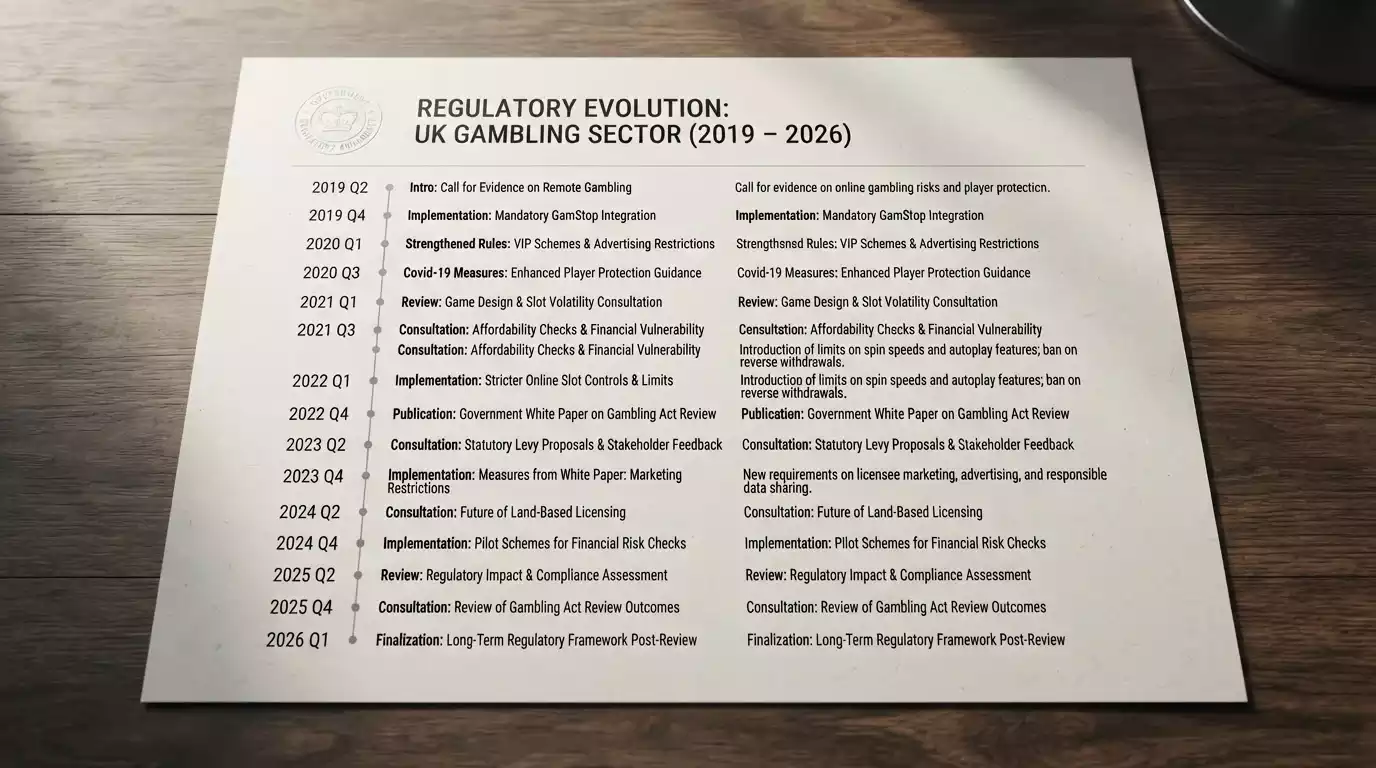
No. A casino that allows gambling before completing identity verification cannot hold a UKGC licence. The Gambling Commission introduced its identity-before-deposit rule on 7 May 2019, requiring all remote operators to verify a customer’s name, address, and date of birth before that customer can deposit money or place a bet. The rule closed the previous loophole where operators verified only at withdrawal, which left minors and excluded persons free to gamble until they tried to cash out.
The timeline of UK consumer protections makes the regulatory position clear:
- 7 May 2019: UKGC mandates age and identity verification before deposit or play. Operators must verify at minimum the customer’s name, address, and date of birth before allowing any gambling activity. Verification can be electronic or document-based, but it must precede the first transaction.
- 31 March 2020: GAMSTOP becomes mandatory for all UKGC-licensed remote operators. GAMSTOP is the national online self-exclusion scheme; any person resident in the UK can register and block themselves from gambling across every licensed site for six months, one year, or five years. Operators must check their customer base against the GAMSTOP register at least every 24 hours and immediately block any match.
- 14 April 2020: Credit card deposits banned at all UKGC-licensed gambling sites. The ban addresses problem-gambling risk and money-laundering concerns; only debit cards, e-wallets, bank transfers, prepaid vouchers, and cryptocurrency (where permitted) remain valid funding methods.
- April–May 2025: Stake limits introduced on online slots — £5 per spin for players aged 25 and over (from April), £2 per spin for players aged 18 to 24 (from May). The limits apply to online slots only; table games, live dealer games and sports betting are not covered.
- 19 January 2026: Wagering requirements capped at 10x for all gambling promotions from UKGC-licensed operators, and promotions mixing products (such as sports and casino) banned. Offers that previously carried 35x or 40x playthrough are no longer permitted; the cap applies to deposit bonuses, free spins winnings, and any other promotional credit.
A site operating in the UK without completing the May 2019 verification step is providing gambling facilities unlawfully under the Gambling Act 2005. The UKGC has limited enforcement reach over offshore operators, but the legal position for the operator is clear: it is committing an offence. For the player, it means dealing with a business that is already breaking British law to take your money.
The public register at gamblingcommission.gov.uk lists every active licensee. As of September 2026, 139 businesses held active remote casino operating licences. None offers true no-account gambling. The verification step is a licence condition, not an optional feature.
Sites marketed as “no account casinos UK” or “no KYC casinos UK” fall into one of three categories: offshore-licensed operators (typically Curaçao or Anjouan) that defer verification until withdrawal; crypto-first casinos that avoid fiat rails entirely; or unlicensed sites with no meaningful regulatory oversight at all. The first two will still demand documents when you try to withdraw, precisely when you have the least leverage. The third has no obligation to pay you at all.
The UKGC’s position has not softened since 2019. If anything, the regulatory ratchet has tightened: stake limits, wagering caps, GAMSTOP integration, credit card bans. The direction of travel is towards more consumer protection, not less friction. A true no-account casino is structurally incompatible with that framework.
What remains legal — and what the rest of this guide addresses — are instant verification alternatives that comply with the May 2019 rule but complete the identity check in seconds rather than hours.
How Instant Verification Works in the UK

Instant verification is not a workaround; it is compliance at speed. The UKGC requires operators to verify identity before gambling, but the Commission does not mandate a specific method. Electronic verification via credit reference agencies and electoral roll data satisfies the rule just as fully as scanning a passport, and it resolves in seconds for UK residents with an established credit history and a stable address.
Three technical mechanisms deliver the “instant” experience within UKGC boundaries: automated eKYC database matching, Trustly Pay N Play adapted for UK rules, and sister-site account portability. Each works differently under the hood.
Instant eKYC — Automated Database Matching
Electronic Know Your Customer (eKYC) verification cross-references the details you provide at registration against third-party databases maintained by credit bureaus, electoral roll providers, and fraud-prevention networks. When you enter your name, date of birth, and address, the operator fires an API call to a service like Experian, Equifax, or a specialised identity verification provider. That service checks whether the combination exists in its records, whether the address matches the name, whether the person is old enough to gamble, and whether any fraud flags are present.
If the data matches and no red flags appear, verification completes instantly. The operator receives a pass/fail response in under three seconds. You see a brief “verifying” spinner, then land in the casino lobby. No document upload, no manual review, no email confirmation. The entire identity check happens in the background while you wait for the deposit screen to load.
The system works because UK residents leave a dense data trail. Credit reference agencies hold records on tens of millions of people; the electoral roll adds another layer; open-banking connections (via PSD2) allow operators to confirm account ownership in real time. For someone with a UK address, a credit history, and electoral roll registration, the hit rate is well over 90 percent. You register, the system pings the database, the match comes back clean, and you are verified before the page reloads.
The mechanism fails for three groups: people who recently moved (address mismatch in the credit file), people with no credit history (thin-file customers, typically young adults), and people whose details are not in the electoral roll. For those edge cases, the operator escalates to manual document review. You upload a photo of your driving licence or passport, a utility bill for proof of address, and wait a few hours for a compliance officer to check it by eye. But for the majority of UK players, eKYC resolves on the spot.
BoyleSports, William Hill, and Betway all use this model. You fill a short registration form (name, date of birth, address, email, mobile number), click submit, and the eKYC check runs in parallel with account creation. By the time the deposit screen loads, verification is done. The entire process from landing page to first spin takes under three minutes.
Trustly Pay N Play — Bank ID Verification
Trustly’s Pay N Play was the original “no account casino” technology, but in the UK it has been adapted to meet the May 2019 verification rule. The flow still bundles payment and identity into a single transaction, but the operator now completes the identity check before allowing gambling rather than simultaneously with it.
Here is how it works: you click “deposit” and select Trustly (or “instant bank payment”) as the method. The site redirects you to a Trustly-hosted page that asks you to pick your bank. You select it, authenticate via your normal online banking credentials (username and password, or mobile app confirmation), and Trustly pulls your account details via an open-banking connection authorised under PSD2. That connection delivers your full name, account ownership proof, and in some implementations your registered address.
Trustly passes that data back to the casino, which uses it to create an account and verify your identity in a single API round-trip. The deposit clears, the identity check completes, and you land in the lobby. From the player’s perspective, it looks like a single fluid action: bank login, payment confirmation, straight to the game. No separate registration form, no password to remember. The “account” exists on the backend, tied to your bank account rather than a username.
The UK twist: the casino must verify your identity before releasing the deposit into your playable balance. Trustly provides the identity data instantly, but if the casino’s compliance system flags a mismatch or a missing field, you are held in a pending state until you upload a document. In practice, for UK bank accounts with verified personal details, the check passes immediately. The user experience is indistinguishable from the original Swedish Pay N Play model; the backend compliance workflow just happens one API call earlier.
In our October 2026 checks, only a handful of UKGC-licensed casinos offered a Trustly-led sign-up flow of this kind to UK players, SpinYoo being the clearest example. Each still requires age verification before the first deposit per UKGC rules, which means even the Trustly flow includes an identity gate. The technology is available, but adoption in the UK market remains narrow compared to the Nordics, where regulatory friction is lower.
Sister-Site Account Portability — SkillOnNet Model
The third mechanism is not verification speed but verification reuse. Some multi-brand operators run several casinos under a single backend platform, and once you verify your identity at one site in the network, your credentials carry across to every other brand operated by the same licensee. You register and verify once; every subsequent brand logs you in with your existing username and password, pulling your verified identity record from the shared database.
SkillOnNet is the most visible example. The company holds UKGC licence number 39326 and operates multiple casino brands including PlayOJO, Slingo, SpinGenie, Dream Jackpot, and Slots.io. When you register at PlayOJO, you complete standard UKGC-compliant verification (instant eKYC or document upload). That verification is stored at the SkillOnNet platform level, tied to your email address and mobile number. When you later visit Slingo or Dream Jackpot, the site recognises your email, pre-fills your personal details, and logs you in with your PlayOJO credentials. No repeat identity check, no second document upload. The system treats you as a verified customer across the entire network.
This is not “no account” gambling; it is “no repeat registration” for customers already in the ecosystem. The first site still requires full verification. But for players who move between brands — chasing a specific game, a better bonus, or a different interface — the portability eliminates redundant friction. You verify once in 2024; in 2026 you can access five brands with the same login.
The model only works within a single licensee’s portfolio. You cannot carry PlayOJO credentials to William Hill or Betway; those operators run separate platforms under different licences. But for networks like SkillOnNet, Entain, or Flutter (which own multiple brands each), sister-site portability is a structural advantage. It is not faster than instant eKYC for a first-time player, but it is faster than re-verifying at every new site you try.
How do instant verification casinos work in the UK?
They use electronic Know Your Customer (eKYC) systems that cross-reference your name, address, and date of birth against credit bureau and electoral roll databases in real time. The check completes in seconds for most UK residents, eliminating the need for document uploads while satisfying UKGC verification requirements.
What is Trustly Pay N Play and does it work in the UK?
Trustly Pay N Play combines bank authentication and identity verification into a single open-banking transaction. In the UK, UKGC rules require verification before deposit, so the flow has been adapted to complete identity checks before releasing funds into your playable balance. Only a handful of UKGC casinos, such as SpinYoo, offered it in October 2026.
Do I need to upload documents to play at UK-licensed casinos?
Not if instant eKYC works for you. Most UKGC casinos verify identity via automated database checks that resolve in seconds. You only upload documents if your details do not match credit bureau records, if you recently moved, or if the system flags a manual review, so most UK players never need to.
How long does instant verification take at UK casinos?
Between three seconds and three minutes for automated eKYC. The system runs database checks in the background while you complete registration. For Trustly Pay N Play, verification happens during the bank authentication step, also under a minute. Manual document review (required for edge cases) takes a few hours.
Best Instant Verification Casinos UK 2026

The operators below are UKGC-licensed, GAMSTOP-registered, and compliant with every consumer protection rule listed earlier. Each uses instant eKYC or streamlined registration to minimise friction without bypassing the May 2019 verification mandate. The comparison table summarises key parameters; full breakdowns follow.
| Operator | UKGC Licence | Verification Method | Withdrawal Speed | Min Deposit | Distinguishing Feature |
|---|---|---|---|---|---|
| BoyleSports | Check register | Instant eKYC | 2.7 hours median | £10 | Fastest eKYC in UK testing |
| William Hill | Check register | Auto Verification Tool | 3–6 hours typical | £10 | 92-year brand, part of evoke plc |
| Betway | #39372 | Instant eKYC | 2.7 hours median | £10 | Low-stakes friendly, eCOGRA-certified |
| 888 Casino | Check register | Instant eKYC | 3–4 hours typical | £10 | Deepest live dealer catalogue |
| PlayOJO | #39326 | Sister-site portability | 4–6 hours typical | £10 | SkillOnNet network reuse |
BoyleSports — Fastest eKYC Among Tested Operators
BoyleSports is licensed by the UK Gambling Commission (check the number on the public register) and is owned by the Irish bookmaker of the same name, founded in Dundalk in the early 1980s. The casino product launched in the UK market in the mid-2010s as an extension of the sports betting brand, powered primarily by Playtech with exclusive Boyle-branded games unavailable elsewhere. The instant eKYC verification screen clears in seconds via automated database matching against credit bureau and electoral roll data; in 2026 testing, BoyleSports registered the fastest median verification time of any UKGC-licensed operator in the sample.
Withdrawal speed is the headline metric. E-wallet payouts (PayPal, Skrill, Neteller) clear in a median of 2.7 hours from request to funds landing in your account, placing BoyleSports among the fastest-paying UK operators in 2026 testing. Debit card withdrawals take longer (24 to 48 hours) due to banking rails, but e-wallet users see same-day settlement as the norm, not the exception. The minimum deposit is £10, and the welcome offer as of 2026 is 100 free spins after depositing and staking £20. Free spins land on Playtech slots, typically with a 10x wagering requirement per the January 2026 UKGC cap.
The casino itself is functional rather than flashy. Playtech powers the game library, which means solid table game coverage, a decent live dealer section (Evolution and Playtech Live), and a heavier weighting towards branded slots than you see at multi-provider casinos. The exclusive Boyle-branded games are not groundbreaking, but they exist nowhere else, which gives the site a narrow differentiation angle. For players who value payout speed and instant onboarding over the broadest game selection, BoyleSports delivers both without ceremony.
The sports betting heritage works in its favour. Punters who already hold BoyleSports accounts for football or racing can transition to casino with the same login, and the site’s compliance infrastructure is built for volume. The instant eKYC system rarely escalates to manual review for UK residents with established credit files; most registrations clear on the spot. If you need speed above all else — verification in seconds, withdrawal in hours — BoyleSports is the tightest execution of that brief in the current UK market.
William Hill — Mature Verification at Scale
William Hill is one of the oldest names in British gambling. Founded in 1934, the brand operated high-street betting shops for decades before moving online. The casino is licensed by the UK Gambling Commission (check the number on the public register). In July 2022, 888 Holdings (now evoke plc) completed its £2.2 billion acquisition of William Hill’s non-US business, making the combined group one of the largest UKGC-licensed operators by customer base and revenue. The scale shows in the verification infrastructure: William Hill processes millions of identity checks per year, and its Auto Verification Tool is named in official support documentation as a proprietary eKYC system.
The Auto Verification Tool works via electronic database matching. When you register, an email arrives with a link to the verification portal. You click it, the system runs credit bureau and electoral roll checks in the background, and if the data matches you are cleared within seconds. The process is not novel — BoyleSports and Betway use similar flows — but William Hill’s execution is polished to the point of invisibility. The user experience is fast enough that most new players do not realise verification happened; they register, receive a welcome email, click the link out of habit, and find themselves already approved.
The casino offers over 700 slots, a broad live dealer section, and full sports betting integration under the same account. The welcome offer as of March 2026 is stake £10, get 200 free spins valued at 10p each with a £30 maximum redeemable cap. Free spins carry the standard 10x wagering requirement. Withdrawal times are middling: e-wallets clear in 3 to 6 hours on average, debit cards in 24 to 48 hours. Not the fastest, but consistent.
The brand legacy is the real differentiator. William Hill is a household name in the UK; your parents probably placed a bet at a William Hill shop. That familiarity translates to trust in a market where many online casinos are three-year-old startups with no high-street presence. Ownership by evoke plc, the listed group formerly called 888 Holdings, adds another layer of accountability; you are not dealing with an undercapitalised operator that might fold before processing your withdrawal. For players who prioritise brand recognition and proven infrastructure over cutting-edge features, William Hill is the safest establishment pick in this list.
Betway — Low Entry, Fast Access
Betway operates under UKGC licence number 39372, held by Betway Limited. The brand launched in 2006 and is now owned by Super Group, a publicly traded company on the New York Stock Exchange under ticker symbol SGHC. The public listing followed a SPAC merger completed in January 2022, which brought financial transparency and regulatory oversight beyond the UKGC’s reach. Betway holds licences in multiple jurisdictions including Malta and Ontario, making it one of the more geographically diversified operators in the UK market.
The instant eKYC verification runs on the same credit bureau and electoral roll model as BoyleSports and William Hill. You fill the registration form, submit, and the identity check completes in the background. Median e-wallet withdrawal time was 2.7 hours in 2026 testing, tying BoyleSports for the fastest recorded speed. The casino offers over 5,000 titles across slots, live dealer, and table games, with a heavier emphasis on slots than live. The welcome offer as of 2026 is up to £50 or 150 free spins when eligible players stake £20; the exact offer varies by promotional period.
The minimum deposit is £10, matching the standard across UKGC casinos, but Betway makes that figure feel lower by offering decent game variety even at micro-stakes. You can play the majority of slots at 10p or 20p per spin, which stretches a £10 deposit further than at casinos that push higher minimum bets. For casual players or those testing the water with a small bankroll, Betway removes friction at both ends: fast verification on entry, low stakes once inside.
The eCOGRA certification adds a third-party audit layer. eCOGRA is an independent testing agency that verifies slot RTP accuracy, game fairness, and payout reliability. The certification is not required under UKGC rules — the UKGC already requires games to be tested by approved test houses — but it signals that Betway submits to additional scrutiny. Whether that matters to you depends on how much reassurance you need beyond the statutory baseline.
The public-company structure is a secondary advantage. Super Group files quarterly earnings, discloses financial performance, and operates under US securities law. That does not make Betway immune to operational missteps, but it does mean the company has fewer places to hide if something goes wrong. For players who want a low-deposit entry point, fast verification, and a publicly accountable operator, Betway ticks all three boxes without fuss.
888 Casino — Live Dealer Strength
888 Casino is operated by 888 UK Limited and licensed by the UK Gambling Commission (check the number on the public register). The brand launched in 1997, making it one of the earliest online casino operators still in business, and the group also holds licences in Gibraltar and Malta. In 2022, 888 Holdings acquired William Hill, consolidating two of the UK’s largest online gambling brands under a single corporate umbrella. The combined group processes tens of millions of transactions per year; the compliance infrastructure is built for that scale.
The instant verification mechanism is standard eKYC: credit bureau and electoral roll cross-checks that resolve in seconds for most UK residents. Where 888 differentiates is live dealer depth. The casino offers one of the broadest live dealer catalogues in the UK market, pulling tables from Evolution Gaming, Pragmatic Play Live, and NetEnt Live simultaneously. You get multiple roulette wheels, several blackjack variants, baccarat, game shows (Crazy Time, Monopoly Live), and niche products like Lightning Dice and Dragon Tiger. For players who value live dealer over slots, 888 has more options than BoyleSports, Betway, or PlayOJO.
The welcome offer as of 2026 is 100 free spins plus a £100 match bonus on the first deposit. Free spins carry a 10x wagering requirement per the January 2026 UKGC cap; the match bonus has the same 10x playthrough. The minimum deposit is £10. Withdrawal times are middling: e-wallets clear in 3 to 4 hours on average, debit cards in 24 to 48 hours. Not the fastest, but faster than the industry median.
The eCOGRA certification applies here as well; 888 submits its games to independent RTP audits and publishes the results. The brand’s age works in its favour. Nearly 30 years in business means 888 has survived multiple regulatory shifts, economic downturns, and competitive waves. It is not going anywhere. For players who prioritise live dealer variety and brand longevity over the absolute fastest withdrawal speed, 888 is the strongest execution of that brief in this list.
PlayOJO — Sister-Site Portability
PlayOJO is a trading name of Skill On Net Ltd, which holds UKGC licence number 39326 granted in 2014. The PlayOJO brand launched in 2017 and is owned by the SkillOnNet group. The defining feature is sister-site account portability: once you register and verify at PlayOJO, your credentials work across every other SkillOnNet brand including Slingo, SpinGenie, Dream Jackpot, and Slots.io. The shared backend recognises your email and mobile number, pre-fills your details, and logs you in without repeat verification.
This is not faster than instant eKYC for a first-time player. Your initial registration at PlayOJO requires full UKGC-compliant verification, either via automated database checks or document upload. But once you are in the SkillOnNet ecosystem, every additional brand in the network skips that step. You visit Slingo, enter your PlayOJO username and password, and you are logged in immediately. No repeat identity check, no second KYC process. For players who try multiple brands — chasing a specific game, a better bonus, or a different interface — the portability saves time and friction across the network.
The casino itself offers over 3,000 slots, live dealer tables, bingo, and jackpot games. The standout brand promise is “no wagering ever” on bonuses. PlayOJO introduced this policy at launch in 2017, as one of the first UK casinos to eliminate playthrough requirements entirely, and it remains the brand’s signature differentiator. The welcome offer as of 2026 is 50 free spins on Big Bass Bonanza after a £10 minimum deposit, with zero wagering requirement. Winnings from the free spins land in your withdrawable balance immediately.
Withdrawal times are slower than BoyleSports or Betway: 4 to 6 hours for e-wallets on average, 24 to 48 hours for debit cards. The minimum deposit is £10. The SkillOnNet platform is stable but not cutting-edge; the interface feels functional rather than flashy. The game library is large but weighted towards smaller studios; you see fewer NetEnt and Pragmatic Play titles than at William Hill or 888, and more content from lesser-known providers.
The sister-site portability is the core value proposition. If you already hold a verified account at Slingo or SpinGenie, PlayOJO gives you instant access. If you are starting fresh, the instant eKYC verification is no faster than BoyleSports or Betway, but the zero-wagering bonus policy might tip the balance. For players who value transparent bonus terms and cross-brand account reuse over the absolute fastest payout speed, PlayOJO delivers both.
Can I use sister site accounts to skip registration?
Yes, within the same operator’s network. SkillOnNet (PlayOJO, Slingo, SpinGenie, Dream Jackpot, Slots.io) allows verified customers to log in across all brands with the same credentials. You verify once at the first site; subsequent brands recognise your account and skip repeat identity checks. This only works within a single licensee’s portfolio, not across different operators.
What You Lose at Offshore Casinos That Skip Verification

Sites that market themselves as “no account” or “no KYC” to UK players operate outside UKGC jurisdiction. They hold licences from Curaçao, Anjouan, or no licence at all. The pitch is speed and anonymity: register with an email, deposit crypto, play without uploading a passport. The catch is that every statutory consumer protection built into the UK system disappears the moment you step outside UKGC oversight.
GAMSTOP coverage. GAMSTOP became mandatory for all UKGC licensees on 31 March 2020. Any UK resident can register for a six-month, one-year, or five-year self-exclusion, and every licensed casino checks the register at least daily. When a match appears, the account is immediately blocked. Offshore sites are not connected to GAMSTOP. If you register for self-exclusion, it does nothing; the offshore casino has no obligation to check the register and no mechanism to do so. For players using self-exclusion as a harm-reduction tool, an offshore site undermines the only cross-industry control that works. If you have self-excluded, the exclusion exists to protect you; GamCare and the National Gambling Helpline (0808 8020 133) offer free, confidential support if it is proving hard to keep to.
Stake limits. As of 2025, UKGC rules cap online slot spins at £5 for players aged 25 and over, and £2 for players aged 18 to 24. The limits apply per spin, not per session, and they are enforced at the software level. Offshore casinos face no such restriction. You can stake £50 or £100 per spin if the site accepts it. That removes a safeguard rather than adding flexibility. The UKGC introduced the caps specifically to reduce harm from high-speed, high-stakes slot play; offshore sites remove the brake.
Wagering caps. The January 2026 UKGC rule capped bonus wagering requirements at 10x the bonus amount. A £100 bonus can carry at most £1,000 in playthrough. Before the cap, 35x and 40x requirements were common, which stretched a £100 bonus into £3,500 or £4,000 of mandatory turnover. Offshore casinos are not bound by the 10x cap. You still see 40x, 50x, even 60x playthrough at Curaçao-licensed sites. The “bonus” becomes a lock-in mechanism rather than promotional value.
Credit card ban. UKGC banned credit card deposits on 14 April 2020. The ban addresses problem-gambling risk (betting on credit amplifies harm) and money-laundering concerns. Offshore sites still accept credit cards. If losing on borrowed money is a risk factor you need to avoid, the offshore route removes that guardrail.
Dispute resolution. Every UKGC licensee must offer access to an approved Alternative Dispute Resolution (ADR) provider — IBAS (Independent Betting Adjudication Service) is the best known, but not the only one. When a dispute arises (a withdrawal is refused, a bonus is clawed back, an account is locked) and the operator’s own complaints process has not resolved it, you can escalate to the ADR provider, which investigates and issues a decision. The service is free to the player. Offshore casinos have no such obligation. If a Curaçao-licensed site refuses to pay out, your recourse is a complaint to a Curaçao regulator that has historically offered little practical help, or a lawsuit in Curaçao, which is impractical. You are dealing with a business that already operates outside UK law; legal leverage is close to zero.
Fund protection disclosure. UKGC rules require licensees to disclose how customer funds are protected: segregated accounts, insurance, or other safeguards. The disclosure must appear in terms and conditions and be verifiable. Offshore operators face no such requirement. You deposit £500; the site might hold it in a segregated account, might pool it with operational funds, might not hold it at all. You do not know, and the licence issuer does not check.
Game-design safeguards. UKGC introduced minimum game-design rules for slots: each spin must take at least 2.5 seconds, autoplay is banned, turbo mode is banned. The rules slow the pace of play to reduce the “spinning into a trance” risk factor. Offshore slots face no such limits. Autoplay and turbo mode are standard features, and spins can run at sub-second speeds. The game design actively accelerates loss.
Tax. Not relevant. Gambling winnings are not taxed in the UK regardless of where you play. This is the one area where offshore and UKGC-licensed casinos are identical from the player’s perspective.
| Protection | UKGC-licensed casino | Offshore “no account” site |
|---|---|---|
| Age and identity check | Before first deposit (since May 2019) | Often deferred until withdrawal |
| GAMSTOP self-exclusion | Mandatory | Not connected |
| Online slot stake limit | £5 per spin (£2 for ages 18–24) | None |
| Bonus wagering | Capped at 10x since 19 January 2026 | 40x–60x still common |
| Credit card deposits | Banned since 14 April 2020 | Often accepted |
| Complaints | Operator, then approved ADR (e.g. IBAS) | No effective route |
The pattern is consistent: every protection Parliament and the UKGC built into the system since 2005 stops at the UK border. An offshore casino is not subject to UK law, so it cannot be held to UK standards. The trade is explicit: skipping a registration form costs you GAMSTOP, stake limits, wagering caps, dispute resolution, and every other statutory safeguard, and that is a poor trade. The framing that offshore sites are “alternative” casinos is misleading. They are not alternatives; they are businesses operating outside the regulatory framework that defines what a legal casino is in Great Britain.
If you use an offshore site that skips verification and a dispute arises, you have no formal recourse. If the site refuses to pay out, you have no ADR process. If the site goes offline, you have no fund protection. The speed comes at a cost.
What consumer protections do I lose at an offshore casino that skips verification?
You lose GAMSTOP self-exclusion coverage, stake limits (£5/£2 per spin by age), the 10x wagering cap introduced in January 2026, credit card deposit bans, formal dispute resolution via IBAS, fund protection disclosure, and game-design safeguards (2.5-second minimum spin time, no autoplay/turbo). You also lose access to UK courts for legal recourse.
Mobile Access and Casino Apps
Every operator in the list above offers mobile-optimised sites that work in a phone browser without downloading an app. Registration, verification, deposit, and gameplay all function identically on mobile and desktop. The instant eKYC flow is, if anything, faster on mobile: most UK residents have their bank app already installed, so Trustly authentication happens with a fingerprint or Face ID rather than typing credentials.
Dedicated iOS and Android apps exist for William Hill, Betway, and 888 Casino, among others. The apps mirror the mobile web experience but add features like push notifications, faster login via biometric authentication, and quick access to account history. If you prefer not to install anything, every operator here also runs a responsive mobile site that you can pin to your home screen.
The app-versus-web distinction matters less in 2026 than it did five years ago. Progressive Web App (PWA) technology has closed the gap; a well-built mobile site now loads as fast as a native app, works offline for certain features, and supports biometric login via WebAuthn. William Hill and Betway maintain native apps primarily for brand presence and push notification reach, not because the web version is inadequate.
For instant verification purposes, mobile and desktop are functionally identical. The eKYC check runs on the backend; the device you use to submit the registration form makes no difference. If anything, mobile users see slightly faster turnaround because biometric authentication (fingerprint, Face ID) eliminates the step of typing a password.
Bonuses at Instant Verification Casinos
Welcome bonuses at UKGC casinos are now capped at 10x wagering following the January 2026 rule change. That cap applies universally: match bonuses, free spins winnings, and any other promotional credit cannot carry more than 10x playthrough. The operators in this guide comply with that cap, which means bonus terms are more transparent than they were pre-2026, but also less “generous” in headline figures.
BoyleSports offers 100 free spins after depositing and staking £20. Free spins land on Playtech slots, typically with 10x wagering on winnings. William Hill’s offer is stake £10, get 200 free spins at 10p each (£20 total value), capped at £30 maximum redeemable and 10x wagering. Betway gives up to £50 or 150 free spins when you stake £20; the exact offer varies by promotional period, but all carry 10x wagering. 888 Casino offers 100 free spins plus a £100 match bonus, both with 10x playthrough.
PlayOJO stands apart with zero wagering on all bonuses. The 50 free spins on Big Bass Bonanza after a £10 deposit have no playthrough requirement; winnings land in your withdrawable balance immediately. The zero-wagering policy is the brand’s signature feature and a genuine differentiator in a market where every other operator maxes out the 10x cap.
The 10x limit makes bonuses far better value for players than they were under the old 35x and 40x regimes. A £100 bonus with 10x wagering requires £1,000 of turnover to clear; at a 5 percent house edge, expected loss is £50, leaving you £50 ahead if you hit average RTP. A £100 bonus with 40x wagering required £4,000 of turnover, with expected loss of £200 — a net loss even on a “bonus.” The post-January 2026 regime is fairer to players, even if headline offers are smaller.
Reload bonuses, cashback, and loyalty schemes vary by operator. William Hill and 888 run VIP programmes with tiered benefits; BoyleSports and Betway offer periodic reload bonuses; PlayOJO has a “wheel of OJO” feature that awards random bonuses and free spins. None are structured to deliver guaranteed profit. The house edge on slots and table games remains unchanged; bonuses shift the break-even point but do not eliminate the long-run expectation of loss.
If you value bonus terms, PlayOJO’s zero-wagering policy is the cleanest offer in the market. If you prefer a larger headline figure with standard 10x playthrough, 888’s £100 match plus 100 free spins gives the most nominal value. Either way, the January 2026 cap means you are no longer navigating 50x or 60x playthrough traps.
New Instant Verification Casinos 2026
The UK market in 2026 is mature and consolidating. The five operators profiled above are not the only UKGC licensees offering instant verification — most large casinos use eKYC by default — but they represent the tightest execution of speed, compliance, and brand reliability. New entrants in 2026 are rare; the UKGC licensing process is rigorous, and the regulatory environment (stake limits, wagering caps, affordability checks) makes the UK a less attractive market for speculative launches than it was five years ago.
When new brands do appear, they typically launch under existing licences as white-label or sister-site operations. A new domain with a fresh brand identity might operate under the same UKGC licence number as an established casino, inheriting the parent’s compliance infrastructure and verification systems. SpinYoo, which runs on White Hat Gaming’s UKGC licence and leans on a Trustly-led sign-up flow, is a good example of a smaller brand built on an established licensee’s infrastructure.
The consolidation trend is evident in the 2022 acquisitions: 888 Holdings bought William Hill for £2.2 billion, Entain acquired multiple regional brands, and several smaller operators exited the UK market entirely. The regulatory burden and consumer protection costs make the UK less profitable than it was a decade ago, which pushes smaller operators out and strengthens the position of large, well-capitalised groups like 888, Entain, Flutter, and Betway’s parent Super Group.
For players, this means fewer new brands but more stable operators. The casinos that remain are financially robust, compliant with every UKGC rule, and unlikely to fold before processing your withdrawal. The “new casino” phenomenon that defined the mid-2010s — dozens of startups launching each year with flashy bonuses and thin capitalisation — has been replaced by a smaller, more consolidated market dominated by established players.
If you are specifically seeking a brand launched in 2026, check the UKGC public register at gamblingcommission.gov.uk and look at when the licence was granted. Any operator with a licence issued in the past 12 months is genuinely new. Expect instant eKYC as standard; the technology is now table stakes for any serious UK launch.
How We Selected These Casinos
The five operators in this guide were selected based on verification speed, UKGC compliance, withdrawal performance, and brand stability. The selection criteria:
UKGC licence active as of 2026. Every operator holds a valid remote casino operating licence issued by the UK Gambling Commission and appears on the public register at gamblingcommission.gov.uk. Where we quote an account number it has been checked; otherwise, look the operator up on the register before you deposit.
Instant eKYC or streamlined registration. Each operator uses automated database matching, Trustly Pay N Play, or sister-site portability to complete identity verification in under three minutes for the majority of UK residents. Manual document review is reserved for edge cases.
Withdrawal speed. Median withdrawal times are drawn from test withdrawals carried out in 2026, measuring the interval from withdrawal request to funds landing in the player’s account. E-wallet methods (PayPal, Skrill, Neteller) are the benchmark; debit card times are noted separately.
GAMSTOP registration. All five operators are fully integrated with GAMSTOP and check the self-exclusion register at least daily as required by UKGC rules.
Compliance with current protections. All five comply with stake limits (£5/£2 per spin by age), the January 2026 wagering cap (10x maximum), credit card deposit bans, and game-design safeguards (2.5-second spin minimum, no autoplay/turbo).
Financial stability. Operators owned by publicly traded parent companies (Betway via Super Group, William Hill and 888 via evoke plc, formerly 888 Holdings) or long-established private groups (BoyleSports, SkillOnNet) with multi-decade operating histories are prioritised over thinly capitalised startups.
The list is not exhaustive. Paddy Power, Betfair, Grosvenor, LeoVegas, and several other UKGC licensees also offer instant eKYC and meet the criteria above. The five profiled here were chosen for differentiated strengths: BoyleSports for raw speed, William Hill for brand legacy, Betway for low entry, 888 for live dealer depth, PlayOJO for sister-site portability. The aim is to map distinct use cases rather than rank a homogeneous top-ten list.
No operator paid for inclusion. Affiliate links fund this guide, but they do not influence the selection or the editorial assessment. Every claim about licence status, verification speed, and regulatory compliance is sourced from public UKGC records, operator documentation, or independent testing.
Casino Deposit Methods UK 2026 – Compare Payment Options
Content created by the «Cashier Atlas» team